Hot Toddy: reinvented {recipes for cold season}

Hot Toddy: reinvented {for cold season}

When I was a child and had a cold my mom always made me a simple, soothing Hot Toddy.

Her version was just hot water with a big squeeze of lemon and a dollop of honey. So warm, comforting, and helpful to clear mucous and congestion.

And today I still reach for this simple remedy at the first hint (or deepest part) of a cold. But today my Hot Toddy comes with a twist (or two) depending on what sort of sick we are and what remedies I have on hand.

Because Mom's Hot Toddy was good. But the Hot Toddy, reinvented? It's even better.

Below you will find my basic Hot Toddy recipe, plus simple variations to help you get on the mend fast.

(An aside: That's a jar of bone broth on the right. Because when you're sick, Hot Toddys are wonderful, but bone broth is too. Be sure to drink lots of chicken stock when you're down with a cold! It's so good, so healing, and so simple to make!)

Hot Toddy: reinvented {recipes for cold season}

The Basic Toddy: Lemon, Ginger, and Honey

Fill a pint jar with boiling water. Add four to six thin slices of ginger and the juice of 1/2 lemon, plus the squeezed out lemon half. (The ginger will boost the cold-fighting powers of the lemon and honey and adds a wonderful warming effect for anyone who is chilled.) Cover and steep for 10 minutes. Cool until quite warm but not hot, then add raw honey to taste.

Drink warm throughout the day.

Hot Toddy: reinvented {recipes for cold season}

The Herbal Toddy: Thyme & Sage

If you have a sore throat or a cough, relief may be as close as your spice cabinet!

Because as it turns out, sage and thyme are not only delicious culinary herbs, but celebrated medicinal herbs as well.

Add a sprig each of fresh or dried thyme and sage to your jar before steeping with the ginger and lemon. Don't have sprigs? Add 1/2 tsp dried thyme and 1 tsp rubbed sage instead. Steep, then strain through a fine mesh strainer. Cool until just warm but not hot, then sweeten to taste with raw honey.

Hot Toddy: reinvented {recipes for cold season}

The Super Toddy: with medicinal herbs

Now we're getting to the good stuff. Because the Herbal Toddy is no more difficult to make than the basic toddy if you have ingredients on hand to put it together. Stock up on these herbs now so you're ready for whatever winter brings! (I buy many at my local food coop, but if you can't buy them locally Mountain Rose Herbs is a great, trusted source to buy online.)

Astragalus Root

Astragalus root is a favorite immune boosting remedy for my family and countless others around the world. Add a slice of astragalus root to your toddy when you begin to steep.

Bring 2 slices of astragalus root and 1 C of water to a simmer in a small sauce pan. Cover and simmer for 15 minutes. The volume of water will have reduced by about 1/3. Add 1 Tb of this decoction to your quart of toddy.

(I also always add astragalus root to my bone broth, too, to boost it's healing power!)

Wild Cherry Bark

Cherry Bark is a wonderful expectorant for deep, chesty coughs. Bring 1 Tb of cherry bark and 1 C of water to a simmer in a small sauce pan. Cover and simmer for 15 minutes. The volume of water will have reduced by about 1/3. Add 1 Tb of this decoction to your quart of toddy.

Monarda Flower and Leaf

Monarda (bee balm) tastes like a it like oregano, but with a bit of a zing. It's an incredible remedy for sore throats and a brilliant immune booster. I keep a jar of monarda tonic on hand (fresh monarda infused honey and brandy) and stir a spoonful in when I add my honey. (I promise you a proper recipe next year during monarda season, but in for now dried monarda will do!)

Add 1 to 2 Tb dried monarda leaves and flowers to your toddy at the beginning of steeping time. Strain out with a mesh strainer before serving.

White Pine Needle

Pine is packed with vitamin c and is a great addition if a cough is involved. Make a white pine needle decoction as follows: Bring 2 Tb of white pine needles and bark and 1 C of water to a simmer in a small sauce pan. Cover and simmer for 15 minutes. The volume of water will have reduced by about 1/3. Add 3-4 Tb of this decoction to your quart of toddy.

Hot Toddy: reinvented {recipes for cold season}

The Toddy with Tincture Shots

Elderberry and Echinacea are my health boosting dynamic duo. I make a batch of tincture of both each fall, then take them often during cold and flu season. Truly, I credit these two herbs from my backyard for how rarely we get sick in our family.

Take up to 2 tsp per hour for adults and 1/2 to 1 tsp per hour for children at the onset of a cold.

: :

Want more recipes?

I shared several hard-hitting of cough remedies in this post about pertussis. Those recipes are helpful for all manner of coughs and colds – not just whooping cough!

Also, my Winter Apothecary booklet is the perfect simple introduction to making plant medicines at home. It includes six nourishing, healing recipes written by myself and another local herbalist.

I am currently donating 100% of proceeds from the sale of this item to aid the Syrian refugee crisis.

This means that your purchase not only helps your family, but helps other families as well.

Win-win!

Be well, friends.

Love,
Rachel


Two words: Bacon Jam

Bacon Jam Recipe www.lusaorganics.typepad.com

Bacon Jam Recipe www.lusaorganics.typepad.com

Bacon Jam Recipe www.lusaorganics.typepad.com

Of all the things that happened this weekend, this is really the only thing I want to talk about right now.

Because it's bacon jam.

Bacon. Jam.

And I pretty much licked out my dutch oven after I jarred this stuff up. It's crazy good.

I mentioned to a friend that I was making bacon jam when we were on the phone and she said (all in a rush), "Bacon Jam? Whoa! What do you eat it on? – – You know what, who cares what you eat it on! How about a spoon?!"

And she's right. Because it's jam, but – bacon.

You really have to taste it to understand.

(My recipe was inspired by Brittany Angell's version from Every Last Crumb.)

Bacon Jam Recipe www.lusaorganics.typepad.com

Bacon Jam Recipe

Ingredients

1 lb smoked high quality bacon (I buy bacon end cuts and trims at our coop. They are perfect for this.)

2 medium yellow onions, sliced

1/3 cup strongly brewed coffee or espresso (I used decaf) or mild chicken stock

1/4 cup maple syrup

1/4 cup coconut sugar

1 Tb apple cider vinegar

black pepper and salt to taste

1 Tb apple cider vinegar (reserved)

Process

In a large skillet or dutch oven, cook bacon until it begins to brown. Do not cook until it's fully crispy, but take it halfway there.

Remove from pan and set aside to cool.

Pour off half of the bacon grease (reserve for other uses).

Transfer onions to still warm skillet. Caramelize onions over low heat, stirring only occasionally (less stirring yields best caramelized results). Cook for ten to fifteen minutes or until onions are translucent and beginning to brown.

While the onions cook, coarsely chop bacon.

Add remaining ingredients with the exception of reserved vinegar. Stir well, then cover pan and cook on very low heat for 3 hours (or transfer to slowcooker if you prefer), stirring every hour or so.

When much of the liquid has cooked down and the jam is somewhat thick and caramelized remove from heat.

Allow jam to cool enough to handle, then transfer to food processor and pulse to chop. Add reserved vinegar. Taste and add additional vinegar, salt, and pepper if desired.

Serve with crackers, brie, grilled chicken or pork, on a frittata, omlette, or – yes – right off the spoon.

Will last 1 week in the fridge or 1 year in the freezer. (Theoretically. Because honestly. Who could make that happen?)

Makes approximately 3 cups.


How to make easy, homemade applesauce (For canning or eating fresh!)

How to make easy, homemade applesauce. (For canning or eating fresh!)

How to make easy, homemade applesauce. (For canning or eating fresh!)

How to make easy, homemade applesauce. (For canning or eating fresh!)

How to make easy, homemade applesauce. (For canning or eating fresh!)

How to make easy, homemade applesauce. (For canning or eating fresh!)

We picked two bushels of apples at the nearby organic orchard about a week ago. And because we don't have a root cellar, keeping them on through winter means freezing or canning.

So we put by a few bags of apple crisp and apple pie filling, ate more than we probably should have, and turned the rest into sauce.

Homemade applesauce.

Until you've made a habit of shunning that flavorless store-bought sort and making your own, you just can't know what you're missing. Because alongside homemade sriracha, dilly beans, and canned tomatoes, applesauce is a pantry staple around here.

If you care to make your own (for canning or fresh eating), my recipe follows!

Easy Homemade Applesauce

(made with or without a food mill)

I will confess to never having made a batch of applesauce this small. Double or triple or exponentially increase as needed. But know that too many apples crammed into a small pot may scorch. So if you're making a bigger batch, divide it among a few large pans.

Ingredients for approximately 7 pints of applesauce

10 lbs apples

1 1/2 c water

optional spices – cardamon, cinnamon, ginger, clove, orange peel, etc.

optional sweetener of your choice

How to make easy, homemade applesauce. (For canning or eating fresh!)

How to make easy, homemade applesauce. (For canning or eating fresh!)

With a food mill

If you have a food mill, making applesauce couldn't be easier. As a bonus, food mill applesauce is often rosy pink from all of those apple peels.

1. Quarter your apples. No need to core or peel them. Remove any bad spots and compost.

2. Combine quartered apple with water in a cooking pot. Ideally you will have a large, thick-bottomed pot. (If your pot is undersized or thin-bottomed, watch your apples carefully to prevent scorching.) Add water and set over medium heat.

3. When the water begins to simmer, carefully stir your apples, then cover the pot and set to low heat.

4. Every five to ten minutes stir your apples. (I prefer a wide wooden spoon or spatula so that I can turn the apples effectively.) If the pan is becoming dry, add another cup of water.

5. After 20 to 40 minutes your apples should be soft. Remove from heat and allow to cool for one hour.

6. Set up your food mill and transfer your partially cooled applesauce into the hopper.

7. Process apples.

How to make easy, homemade applesauce. (For canning or eating fresh!)

How to make easy, homemade applesauce. (For canning or eating fresh!)

7. Return processed applesauce to cooking pot. Taste and adjust flavor as desired. You may choose to add sweetener, cinnamon, ginger, or other spices. (We left our batch plain.)

8. If you will be canning your applesauce, bring to a simmer over low heat before packing jars.

9. Hot water bath can for 15 minutes for pints or half-pints, 20 minutes for quarts.

10. Enjoy!

How to make easy, homemade applesauce. (For canning or eating fresh!)

Without a food mill

If you don't have a food mill, making applesauce is still easy! There is just a different first step you need to take. The best part of not having a mill? Perfect. Chunky. Applesauce. Oh, yes.

1. Peel and core your apples, then cut into approximately 1" cubes. Remove any bad spots and compost.

2. Combine your prepared apple with water in a cooking pot. Ideally you will have a large, thick-bottomed pot. (If your pot is undersized or thin-bottomed, watch your apples carefully to prevent scorching.) Add water and set over medium heat.

3. When the water begins to simmer, carefully stir your apples, then cover the pot and set to low heat.

4. Every five to ten minutes stir your apples. (I prefer a wide wooden spoon or spatula so that I can turn the apples effectively.) If the pan is becoming dry, add another cup of water. After 20 to 30 minutes your apples should be soft.

5. For chunky applesauce, proceed to step six. For smooth applesauce, either puree with an immersion blender while hot or allow to cool for one hour, then puree in batches in your blender. (Do not puree hot applesauce in your blender as it can volcano out the top!)

6. Return processed applesauce to cooking pot. Taste and adjust flavor as desired. You may choose to add sweetener, cinnamon, ginger, or other spices. (We left our batch plain.) If you won't be canning your applesauce, simmer with optional spices/sweetener for five minutes, then cool and refrigerate or freeze.

8. If you will be canning your applesauce bring to a simmer over low heat before packing jars.

9. Hot water bath can for 15 minutes for pints or half-pints, 20 minutes for quarts.

10. Enjoy!


P.S. When did this applesauce helper…

How to make easy, homemade applesauce. (For canning or eating fresh!)

…become this one?

Oh, my heart.

How to make easy, homemade applesauce. (For canning or eating fresh!)


Homemade sriracha recipe

6a010535f3a090970c017c3219d28b970b

6a010535f3a090970c017c3219d111970b

6a010535f3a090970c017c3219d28b970b

Homemade sriracha (aka "Rooster Sauce") is oh-so-easy. We've been eating the store bought stuff for years, but Pete read the label recently and we realized that as good as it tasted we just weren't the biggest fans of the preservatives that our favorite brand was adding.

And really, it's so simple. I'm not sure why we haven't been making it all along. It's the perfect blend of chilies, garlic, sweetness and vinegar. The recipe I started with came from here. I modified it to suit our preference, and I've included my version is below.

A note about chilies: please, please wear gloves when you seed your hot peppers. Otherwise you might find yourself up all night, crying with your burning fingers in a bowl of ice water. Or so I am told.

Also a note on color: my rooster sauce is a deep rosy orange rather than the red of purchased sauce. I'm down with that. I buy my peppers from my Amish farmer friend Mary and she grows just about everything. So that's what I get and that's what I used.

6a010535f3a090970c017c3219d1bc970b

Homemade Sriracha Rooster Sauce

  • 1 lb of assorted hot chilies, stemmed, seeded (leave more seeds in for more heat), and chopped
  • 1 to 2 heads of garlic (about 8 to 10 average sized cloves), peeled and smashed
  • 2 tsp salt
  • 1 cup white vinegar
  • 1 cup apple cider vinegar
  • 3 Tb honey

6a010535f3a090970c017ee3c40c2a970d

Make it!

Combine chilies, garlic, salt, and vinegars in a sauce pan. Simmer for 20 to 30 minutes to soften peppers and garlic.

Add honey, remove from heat and allow to cool somewhat.  

Blending hot liquids, especially hot siracha is insanity and can send you to the emergency room. Know how to do this properly to prevent a siracha blender volcano. Because that would be terrible in so many ways. Cool first, then start at your blender's lowest speed.

When somewhat cooled, puree until completely smooth in your blender or in the pan with a submersion blender. Depending on your equipment this will take up to 4 or 5 minutes. In my Vitamix it was fast, but if your blender lacks oomph give it plenty of time.

Allow to sit before you take the cover off of the blender. Don't breathe the steam as it is spicy and will take your breath away! 

Return to pan and over medium-low heat to a simmer.

Homemade sriracha | Clean : : the LuSa Organics Blog

Preserve it!

If you want to you can freezer your sriracha in small jars (or make a smaller batch and just keep it in the fridge), but I chose to can mine. Using the basic canning process I outlined here, can in quarter-pint or half-pint jars in a hot water bath for 15 minutes.

As for how many jars, well… I have no idea. Because:

1) I was so excited about it I keep giving it away to friends, and

2) Pete and his sister (who has spent the past three months with us) are so crazy about it I think the're downing entire jars with breakfast

I will make this every year from here on our. We love it more than my salsa. It's that good.

Edited to add: I just made a batch today and yield is around 5 half-pint jars of spicy goodness. The recipe doubles (or triples, or… well, today I made a 5x batch) beautifully.

Enjoy!

Love,
Rachel

 P.S. Here is a printable version for those who prefer a hard copy: Download HomemadeSiracha


Originally posted in 2012.


Sunshine Jam Recipe (peach, raspberry & ginger jam, sweetened with honey)

Sunshine Jam Recipe (peach, raspberry & ginger jam, sweetened with honey) Clean www.lusaorganics.typepad.com

Sunshine Jam Recipe (peach, raspberry & ginger jam, sweetened with honey) Clean www.lusaorganics.typepad.com

Sunshine Jam Recipe (peach, raspberry & ginger jam, sweetened with honey) Clean www.lusaorganics.typepad.com

Sunshine Jam Recipe (peach, raspberry & ginger jam, sweetened with honey) Clean www.lusaorganics.typepad.com

Sunshine Jam Recipe (peach, raspberry & ginger jam, sweetened with honey) Clean www.lusaorganics.typepad.com

As I type this for you today my table is covered – covered! – in quarts of raspberries.

A kind-hearted neighbor invited us to pick last night. Just as he has done every August since we first moved here.

His berries are sustainably grown and he accepts no payment for the fruit he so generously shares (unless you count the jams and dilly beans we leave on his porch.) Last night we came home with not only ten quarts of berries but also a box of tomatoes and a couple of watermelons from his housemate.

Such a deal.

We left them a jar of Sunshine Jam as a small thank you for the epic haul of organic food. Though a tragically undersized token of our thanks, it seemed apropos in content since the raspberries inside are from his farm.

When we got home I poured one quart of fresh berries into a mason jar, added a few slices of fresh ginger root, and covered it in vodka. That will be a gift for our neighbor in a week or so.

Because, why not? You can only eat so much jam and I suspect I'm not the only one leaving jam on his porch ever week or two.

But you still need jam, don't you friends? I thought so.

I developed this recipe over the weekend with our first raspberry harvest. It's so good that I'm making a second batch today. Maybe a double.

Care to join me? Here's my recipe.

(Before we dig in, please note that I use Pamona's pectin. It's the only pectin I know of that still works when you sweeten with honey. I buy it at our natural foods coop.)

Sunshine Jam Recipe (peach, raspberry & ginger jam, sweetened with honey) Clean www.lusaorganics.typepad.com

Sunshine Jam

with peaches, raspberries, & ginger

(makes approximately 9 half-pint jars)

Ingredients

3 C raspberries

6 C peaches, pitted and chopped

1/4 C + 2 TB lemon juice

1 1/2 C local honey

2 TB Pomona's Pectin powder

2 TB + 2 tsp Pomona's calcium water (included with Pomona's Pectin)

1 Tb ginger root, peeled and grated

1 tsp dry ginger

2 tsp ground cardamon (optional)

Process

Prepare Jars, Lids and Canner

Sterilize 9 half-pint or 14 quarter-pint canning jars and their lids in boiling water.

Fill your canner with water and set on high heat to bring to a boil.

Turn off heat when it reaches a boil.

Prepare your Jam

Combine peaches, rapsberries and their juices with calcium water in a medium sized cooking pot. (Mix calcium water according to package directions.)

Add lemon juice, ginger root and dry spices and stir to combine.

Bring fruit to a low boil over medium heat, stirring frequently.

Meanwhile, combine room temperature honey with pectin powder and stir well until fully combined and free of lumps.

When fruit begins to boil, add honey-pectin mix and stir well until honey is completely dissolved.

Taste for sweetness and add additional honey if needed.

Bring to a boil again, then remove from heat.

Jar it up

Fill sterilized jars to 1/4" from top. (I find that this works out perfectly to be just beyond the bottom of my canning funnel.)

Wipe jar rims with a damp towel.

Lid jars with sterilized lids.

Lower jars carefully into your almost boiling water in your canner and set over medium-high heat.

Bring to a boil again, then simmer for 10 minutes.

After 10 minutes lift jars out and allow to cool, undisturbed on a towel for at least 2 hours.

After 2 hours check each lid for a good seal, then allow to rest for 24 hours.

After 24 hours check lids again and move your preserves to your pantry.

Peach & raspberry cobbler recipe (GF, DF, EF, vegan)

Everybody's Peach Cobbler Recipe | Clean www.lusaorganics.typepad.com

Everybody's Peach Cobbler Recipe | Clean www.lusaorganics.typepad.com

Everybody's Peach Cobbler Recipe | Clean www.lusaorganics.typepad.com

Everybody's Peach Cobbler Recipe | Clean www.lusaorganics.typepad.com

Everybody's Peach Cobbler Recipe | Clean www.lusaorganics.typepad.com

Everybody's Peach Cobbler Recipe | Clean www.lusaorganics.typepad.com

Everybody's Peach Cobbler Recipe | Clean www.lusaorganics.typepad.com

Everybody's Peach Cobbler Recipe | Clean www.lusaorganics.typepad.com

Everybody's Peach Cobbler Recipe | Clean www.lusaorganics.typepad.com

After my last peach adventure I took a year off from buying peaches.

It felt like a good choice, considering.

But when a friend cued me in on a bulk buy of organic peaches that a local farmer was organizing I had to join in the madness.

Only two bushels, I said.

I could restrain myself.

Really I could.

They ripened after a few days on our shady porch, and only one was lost to marauding wild life. (A song bird found her way into the box and devoured our ripest peach. I guess she feels the same way I do about peaches.)

 And so, this weekend at our farm, Saturday was Peach Day.

The kids and I bagged and froze diced peaches that we'll use in winter smoothies, muffins, and other treats. Then I canned peach-raspberry-ginger jam (I'll share that recipe too if you're interested!) and my favorite, a mildly spicy, kid-friendly, tomato-free peach salsa with just a few hot peppers from the garden (a crazy addictive recipe I found in this book).

We had cobbler for breakfast on Saturday too, because, well, why not? It's only peach season once a year.

And I jotted down my cobbler recipe to share with you today.

Because it's gluten-free, refined sugar-free, vegan, and can be made either nut-free or grain-free (and by subbing sweeteners you can even make it GAPS legal and Paleo), I named it Everybody's Cobbler.

The kids each made an additional cobbler batch to stash in the freezer, too. (Sage subbed in blueberries for the raspberries and added 2 Tb lemon juice.)

DSC_9862

Everybody's Cobbler

Ingredients

Fruit filling

7 fresh, ripe peaches, pitted and cut into bite-sized pieces (approximately 7 C)

1 1/4 C fresh raspberries (if using frozen, thaw first and drain off excess juice)

1/4 C plus 2 Tb coconut sugar

1/2 tsp peeled and grated fresh ginger root

pinch salt

1 tsp ground cardamon

1/4 tsp dried ginger root

2 Tb coconut flour

2 Tb tapioca flour

Topping

1 c rolled oats (or chopped nuts, coconut, or a combination)

1 c almond flour (or oat flour, your choice)

1/4 c sugar

1/3 c tapioca flour

1 tsp cinnamon

1 c coconut oil, melted

Preheat oven to 350 F and prepare your cobbler pan by lightly oiling a large pie pan or 8×8 oven-safe dish.  (I used coconut oil.)

Combine fruit filling ingredients in a large mixing bowl and topping ingredients in a second, smaller mixing bowl.

Stir each to combine.

Allow fruit filling to sit for ten minutes. If it is exceptionally juicy add an additional tsp each of tapioca flour and coconut flour.

Transfer fruit filling to prepared pie pan and top with oat/almond crumble topping

Place pie pan on a cookie to catch drips. Bake for approximately 40 minutes until bubbling and nicely browned on the top.

Allow to cool somewhat before serving, and enjoy!

(Since we ate ours for breakfast we served it with fresh, homemade yogurt or coconut yogurt. Needless to say, homemade vanilla ice cream would be a win as well.)


Supplements for healthy teeth: Holistic Tooth Care, Part Three

Supplements for healthy teeth: Holistic Tooth Care, Part Three

Last fall I began my three part series outlining how we managed ECCs (early childhood caries) in our home as well as normal, run-of-the mill tooth troubles and decay. It's been a big series to put together, but finally (finally!) I have finished step 3.

You can find the rest of the series here.

Part One: Hygiene

Part Two: Diet

Part Three: Supplements

If you're just joining us now, I urge you go back and read parts one and two before digging in with supplements. While starting with supplements may be a tempting easy fix, supplements alone won't get to the heart of the issue and cause healing. 

Holistic Tooth Care, Part Three: Supplements

As some of you know we're not supplement-crazy over here. I am not a fan of vitamin pills and prefer instead to nourish my family with healthy, whole foods that provide us the nutrients our bodies need.

That being said, there are a few supplements we keep on hand and rely on. And as we have worked our way through several healing crisis through the years, I find the same supplements often bring healing for a variety of conditions.

We have used the supplements below to heal everything from tooth decay to anxiety to eczema. (All of those things along with diet changes as well, of course.) I believe our modern diet – even as healthy as we can make it – is often lacking in the vital nutrients these supplements provide.

Here are the few that we do take, along with some options depending on your budget.

Supplements for healthy teeth: Holistic Tooth Care, Part Three

I have broken the supplements down into two groups below, "Vital Supplements" and "Good to Have". I suggest adding all that you can, but if you aren't up for the whole shebang then I suggest you begin by adding the supplements on the "Vital" list.

Vital Supplements for Tooth Health

Fermented Cod Liver Oil and Butter Oil (best option)

The addition of fermented cod liver oil and butter oil to the diet to heal tooth decay is based on the work of Weston Price. They are a very available source of vitamins A, D, and K2 and are ideal for healing or maintaining healthy teeth.

Fermented cod liver oil (1 tsp/day)

The single most important supplement we have provided for our family is Green Pastures Fermented Cold Liver Oil (FCLO). We began taking FCLO when Lupine was at the peak of her tooth decay and along with daily bone broth supplements I feel this was a key step in stopping her decay.

It. Is. Expensive. But then so is dental work, so for our family we made it work. Yes, there are times we can't afford to restock. But we save up until we can and then try to keep a bottle on hand at all times. Buying with other families reduces the cost as well since Green Pastures offers a case discount.

I understand that this supplement isn't in everyone's budget to take, but if it is within your means buy some and start taking it immediately.

Fermented Cod Liver Oil differs from other fish oils in how the fats are extracted. Rather than using heat (which destroys the natural vitamins D and A found in the liver) they are extracted slowly using a natural fermentation process.

Substituting other fish oils will not achieve the same goal for healing teeth or slowing decay.

Butter oil (1 tsp/day)

At the same time that we added FCLO to our daily routine we also added Green Pastures Butter Oil. Also extracted without heat, Butter Oil provides a dose of K2 to the body, a vital nutrient that was only discovered recently.

K2 appears to be a key in healthy teeth, especially when used in conjunction with FCLO.

Butter oil is also pricey. If you can not purchase this supplement be sure to include plenty of fresh, raw grassfed dairy in your diet.

OR Vitamin D and K2 supplements (second best choice)

If FCLO and Butter Oil are out of your budget or if you simply can't stomach them, a second option is to supplement with the appropriate amounts of vitamins D and K2.

We tried Dental Essentials for Sage who found it much easier to take than the two oils above. Since his teeth are solid I was fine with him using this supplement but never used them for Lupine since she loved the FCLO and butter oil.

When I spoke with someone at Dental Essentials about the source of the vitamins in their tooth health supplements they were straightforward and told me that if our family could take the Green Pastures products that was idea, but if our kids struggled to take them (which Sage does) then their product was a great option.

I agree. While it is not a naturally sourced supplement, these vitamins are vital to tooth health and even a less than ideal delivery is a very good option for many families. (Especially if the FCLO and butter oil are out of your budget.)

A vitamin D level test might be prudent to determine your child's baseline as well.

Supplements for healthy teeth: Holistic Tooth Care, Part Three

Good Additions for Healthy Teeth

Magnesium

More than 80% of Americans are magnesium deficient – thanks to depleted soils, lifestyle choices, diet, and our health. (More on the reasons here.)

And while we think calcium equals health teeth and bones, magnesium is key for the absorption of calcium. They go hand in hand. Without magnesium you can't absorb that calcium! And if 80% of us are deficient, what does that say about the health of our teeth?

Magnesium Calm is a good choice for an oral magnesium supplement, but topical is best when dealing with tooth decay since Calm is slightly acidic and quite sweet. 

You can find my DIY Magnesium Oil recipe here.

Probiotics

In part two I outlined foods to add, including an abundance of live-fermented foods.

I list probiotics here as well because while we do not often supplement with one, for some families it is a more efficient way to ensure a child consumes enough gut-healthy flora.

When we take a probiotic in addition to eating live fermented foods, I prefer Bio-Kult and Three Lac.

Trace Minerals

Healthy teeth require more than just calcium and magnesium. Get a variety of trace minerals through a purchased supplement, or better yet by adding kelp to your diet and choosing unprocessed sea salt in place of table salt. (Himalayan pink salt or Celtic grey salt are both great choices.)

Calc Phos and Calc Fluor Cell Salts

Finally, we took the homeopathic cell salts calc phos and calc fluor. I honestly can not say if this worked, but it didn't hurt and was an easy supplement to add to our regiment.

Take three pellets each per day apart from food and dissolve under tongue.

Supplements for healthy teeth: Holistic Tooth Care, Part Three

And that, my friends, is what it takes! By setting in motion the steps outlined in all three posts in this series you can find tooth health again.

I know that we did.

: :

If you are dealing with a tooth crisis in your home I suggest you do a little homework now by reading this thread on Mothering.com. It will take you several days to work your way thorough (take your time) but it's absolutely rich with information that can help get your family moving in a healthy direction.

Please note: I am neither a dentist nor an expert. The information above is based on our unique experiences as a family, and is not intended as medical advice. Work together with a holistic dentist and find a course of action that works best for your family.

If this post left you with questions or a hunger for more information I suggest the book Cure Tooth Decay and this thread on Mothering.com.

I also strongly recommend Nourishing Traditions. While we don't follow a strictly Weston Price style diet any more, during our crisis it was immensely helpful. During our time of acute decay this book was an indispensable resource that helped us re-learn how to eat.

Another wonderful book to pick up to help you find a new relationship with food is Practical Paleo. So much wonderful information there on how our food choices effect our health.

None of the links above are affiliate links. Just my own opinions! I was not compensated for this post in any way.

Blueberry crisp for dinner (recipe!)

Blueberry crisp for dinner (GF/DF/EF recipe included)

Blueberry crisp for dinner (GF/DF/EF recipe included)

Blueberry crisp for dinner (GF/DF/EF recipe included)

Blueberry crisp for dinner (GF/DF/EF recipe included)

Blueberry crisp for dinner (GF/DF/EF recipe included)

Blueberry crisp for dinner (GF/DF/EF recipe included)

Blueberry crisp for dinner (GF/DF/EF recipe included)

Blueberry crisp for dinner (GF/DF/EF recipe included)

Blueberry crisp for dinner (GF/DF/EF recipe included)

Blueberry crisp for dinner (GF/DF/EF recipe included)

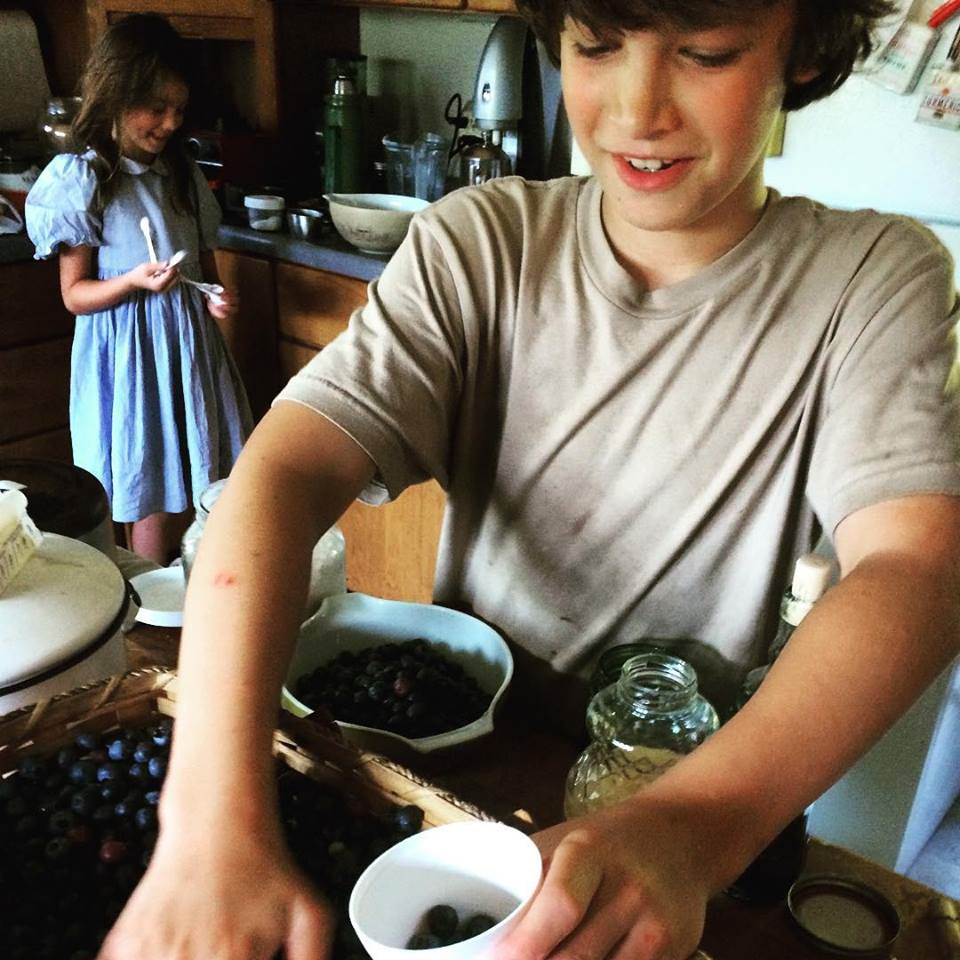
This weekend we made our annual pilgrimage to the non-spray blueberry farm 1 1/2 hours from home.

Each time we make the long drive there I put "grow blueberries" (with lots of asterisks in front) on my farm to-do list. But then each year (like the one before) mid-summer rolls around again and with no blueberry bushes at home, we set out once more.

This time my mom went with us and braved the 90 F day to pick berries with the kids and I for a couple of hours. We came home hot and tired, but with thirty-some pounds of berries to eat, jam, and freeze.

I even managed to keep all of my "kerplink, kerplank, kerplunks" inside while my almost teenager picked once more into a small tin pail.

(You're welcome, Sage.)

But the best part came when we got home.

Back in the kitchen, we did what we always do after picking: we made a fruit crisp for dinner.

Blueberry crisp for dinner (GF/DF/EF recipe included)

It's our tradition. Every time we go fruit picking we have crisp (or cobbler or crumble, depending on where you hail from) for dinner.

No meat, no veggies – just dessert. These small but significant traditions are the things I hope they remember.

I know that I will.

Blueberry Crisp Recipe (EF/DF/GF/Vegan)

Ingredients
Fruit Layer
  • 5 C fresh or frozen blueberries
  • 1/2 to 3/4 C maple syrup, depending on tartness of your blueberry variety
  • 2 Tbsp tapioca flour
  • 2 tsp vanilla
  • 2 tsp grated fresh ginger root (optional)

Crisp Topping

  • 1/2 C coconut sugar
  • 1/3 cup tapioca flour
  • 1 1/4 cup gluten free oats or chopped nuts
  • 1/2 cup almond flour
  • pinch salt
  • 1/2 cup melted coconut oil

Process

Preheat oven to 350 F.

Generously butter a 9×13 baking pan.

Combine all fruit layer ingredients in a large bowl.

Taste for sweetness then transfer to prepared baking pan.

Combine topping ingredients and crumble over berries.

Bake for 55 minutes or until topping has become a lovely and toasty brown.

 Top with sour cream, yogurt, coconut yogurt, or vanilla ice cream (recipe here for a great, simple, homemade vanilla). So good.


You can find my other blueberry recipes through the links below!

Blueberry Buttermilk Ice Cream

Blueberry Jam (three ways)


How to make and can bone broth

How to make and can bone broth

If you asked me what our family's most important, most healing, most nourishing food is I would answer without hesitation. Bone broth.

Rich, long-simmered, nutrient-rich bone broth.

I make a batch weekly and we drink it by the mug-full, cook vegetables or meat in it, and transform it into soups and stews once or twice a week.

Made with kitchen scraps and bones of any sort, we strive to eat a serious amount of this every week. When we're sick or wrestling with tooth decay or food sensitivities we up the quantity to 1 quart per day for adults and 1 pint per day for kids. That's a lot of broth!

How to make and can bone broth

And sometimes it's nice to make a huge batch and tuck it away for late use. Normally I freeze stock in quarts but taking most of a day to thaw a jar of stock requires forethought that I don't always have.

Plus I'm a master at breaking jars with this method, so. You know. Running low on jars after a while.

Enter the pressure canner.

Pressure canning stock is the easiest way to get started with your pressure canner. It's a no-brainer of a formula, and if you're nervous about using your pressure canner it's the idea first batch. 

It took me a while to build my courage for this kitchen experiment, but after I got a friend hooked on broth she returned the favor by getting me hooked on pressure canning it. It was easier than I thought, and the luxury of not having to thaw broth every two days? It's genius.

How to make and can bone broth

Ready to give it a go? Here's how.

First, let's make some stock.

What kind? That's entirely up to you. Fish, chicken, lamb, beef, venison – anything goes!

While the jars in the photos below are lamb stock, chicken is even more common around here.

How to make and can bone broth

Basic Bone Broth Recipe

It's so. Darn. Easy. And delicious. (Really!) Here's how to make 1/2 gallon or more in four easy steps.

1. Save any bones from your weekly meals in a bag in the freezer. Fish, chicken, turkey, duck, beef, venison, lamb, beef… you get the idea. You can also purchase bones inexpensively at your local grocery or coop. Throughout the week add any carrot and celery trims, onion ends and peels, and garlic trims to the bag.

2. On stock making day transfer your bag of bones and vegetable scraps to a slowcooker or large soup pot. Add an extra head of garlic cut in half across the cloves (don't bother peeling or separating cloves) and a small onion or carrot if your veggie scraps aren't abundant. No need to chop or peel anything. Just toss them in whole.

How many bones and how much vegetables should you add? It's adaptable. For chicken stock aim for one chicken carcass, one medium onion, one celery stalk and one medium carrot as a good place to start for an average (8-12 quart) stock pot.

Add twelve peppercorns, one bay leaf and (optional) one 2" knob of ginger root, cut in half and smashed with the blunt end of a knife.

3. Cover everything with water and add 2 Tb apple cider vinegar. The vinegar is important. It helps extract the minerals for the bones into the broth, which it what we're after. Set aside for one hour while the vinegar starts to work it's way into the bones.

4. Bring to a gentle boil, reduce to a simmer, and cook covered on very low heat. Leave on low heat for 24 hours for small bones (chicken and fish) and 48 hours or more for large (cut beef, lamb, or venison bones). Add water as needed. You can begin drawing off your stock and replacing what you take with water after just six hours. But the longer you simmer the more mineral rich your broth will be.

How to make and can bone broth

Now it's time to can!

Fill your quart or pint jars to within 1" of the rim. Dip a cotton cloth or paper towel in white vinegar and wipe the rim of your jars. This will ensure a clean rim and a good seal. You can also use water but I'm partial to the vinegar trick.

Put your lids in a pot of just boiled water to soften the rings. (If you are buying new lids this season check the box label. The newest BPA-free lids on the market you skip this step for.)

Top your jars with lids and screw on rings "finger tight". (If you are unsure how tight that is simply tighten the rings fully, the loosen approximately 1/2".

How to make and can bone broth

Meanwhile, heat approximately 3" – 4" of water in your pressure canner. (Unlike a water bath canner you don't submerge your jars fully in a pressure canner. The steam pressure does the work this time, not the simmering water.) Add a splash of vinegar if you have hard water to prevent minerals from coating the outside of your jars.

When your jars are full and lidded and the canner is simmering, it's time to load up! Affix the lid on your canner but don't engage your weight yet.

Watch your canner. When a plume of steam escapes from the valve set a timer for 10 minutes. Keep the heat on under your canner. (Waiting for the steam plume to start in earnest can take an additional 5 – 15 minutes.)

How to make and can bone broth

When your timer goes off it's time to apply the pressure! Set your weight to 10 lbs of pressure. Keep the heat on and when the weight begins to rattle set your timer. How long you maintain pressure depends on your jar sizes:

Quarts: 25 minutes

Pints: 20 minutes

I always adjust the heat so that my weight is rattling on and off every few seconds rather than a constant rattle that makes me think my pressure canner might explode at any moment. You don't want long gaps between rattles, but two to three seconds is great.)

When your timer goes off turn off the burner. Don't you open the canner! Don't even try. And don't quick-cool the lid by draping a damp towel over it. Just leave it be. Seriously. Otherwise you're fixing for an exploding broth disaster. For. Real.

Allow your canner to cool for 45 minutes or more, then remove the weight and carefully remove the lid.

How to make and can bone broth

Use a jar lifted to carefully remove your jars and place them on a towel to cool. Oh, and they will likely still be boiling away inside the jars, a bizarre sight to behold on the counter top.

If you are using Tattler BPA-free lids, then using a hot pad for each hand, tighten your rings and allow the jars to cool for four hours. If you are using regular lids, simply remove and leave the lids be.

After four hours check that your lids have sealed by pushing down on the center of the lid. If the lid is sucked down it is sealed. If not transfer to the fridge and use within a week or transfer to wide-mouth pints filled 3/4 full and freeze.

Allow the sealed jars to sit undisturbed for 12 hours.

After 12 hours remove rings, double-check that the lids are tightly sealed, label and transfer to your pantry.

You did it! Take a bow.

Thin and crispy grain-free pizza crust recipe (gluten-free, grain-free, egg-free)

Thin and crispy grain-free pizza crust recipe (gluten-free, grain-free, egg-free)

I've been holding out on you for way too long.

Way. Too. Long.

Because we've done it over here. We've perfected the crispy grain-free pizza crust.

I know.

You thought you were destined to eat sloppy grain-free pizza with a spoon for eternity, like some sad sap from Greek mythology. Well no more! I'm here to save you from that culinary destiny.

Because a crispy crust is where it's at.

I'll be brief, because you've got pizza to make, but the back-story is that the matrix of food sensitivities in our house means meals need to be egg-free, gluten-free, and corn-free for happy bellies to result. What did that pizza crust look like? Either a pound of hamburger or a grated zucchini.

Yum.

But then I found this lovely recipe a year or so ago which met nearly all of our meals and so I ran with it, tweaking it to fit our dietary needs and our taste preferences. And I love where we ended up so much that we eat it once a week, without fail. And we have for over a year. 

I know. I should have told you sooner. It might have changed 2014 entirely. 

Forgive me.

Well timing be damned, here it is. The pizza of your dreams.

Can I get a heck yes?

Because: crispy. grain-free. pizza.

Pinch me.

If your people eat eggs feel free to substitute two eggs for the flax and water below. If you are dairy free I have no idea how to help you.

Thin and crispy grain-free pizza crust recipe (gluten-free, grain-free, egg-free)

Thin and Crispy Grain-Free Pizza Crust

gluten-free, grain-free, egg-free

Makes four large pizzas because it's so good that any less would be ridiculous.

If you have more self-control than we do you can also bake and freeze extra crusts for next week. And if you have less self control the recipe doubles beautifully. Ask me how I know.

Ingredients

2 Tb flax seeds, ground (or 2 Tb whole chia seeds)
1/3 c water
1 C milk
5 Tb butter
3 1/2 C tapioca flour
5 TB almond flour (or 2 Tb additional tapioca flour)
1 TB coconut flour (or 1 Tb additional tapioca flour)
1 tsp salt
1/4 tsp garlic powder or one clove fresh garlic, minced (optional, omit if you will be making a dessert pizza as well)
1 packed cup grated Parmesan cheese

Process

Combine ground flax seeds and water. Stir and refrigerate for 20 minutes to allow flax to absorb water and become more "eggy". (In a pinch you can just let it sit long enough to prepare your other ingredients. It'll be fine. I promise.)

Preheat oven to 500 F.

Heat milk and butter until butter is melted and milk is piping hot. Remove from heat and cool slightly.

In a large mixing bowl combine flours, salt, and garlic. Add hot milk and butter mixture and stir to combine. Add flax/water mixture and stir. (If you are substituting actual eggs allow your crust mixture to cool before adding them.)

When combined, add grated Parmesan cheese. Mix cheese into dough with a strong spoon and/or your bare hands. Let dough rest for 5 minutes. If dough is still quite sticky after the five minute rest, work in additional tapioca flour 1 TB at a time until it reached a less sticky, more stretchy consistency.

Thin and crispy grain-free pizza crust recipe (gluten-free, grain-free, egg-free)

Divide dough into four balls. Roll out into a large, thin circle between two sheets of parchment paper. Transfer to a cast iron skillet, hot pizza stone, pizza pan, or cookie sheet. (We use cast iron because we have a few different sized pans and the cooking time is based on cast iron.)

Use your fingers to shape the crust to fit your pan if using a cast iron skillet.

Prick with a fork over entire surface to reduce bubbles.

Bake for 12 minutes or until crust is firm to the touch and just beginning to brown. (Watch the thin spots. You don't want it to get too brown. That crust at the bottom left in the photo below went just a touch too far and won't be as fun to eat.)

Thin and crispy grain-free pizza crust recipe (gluten-free, grain-free, egg-free)

Remove crusts from oven and then remove them from the cast iron pan to prevent overcooking.

Reduce heat to 450.

Make a party out of this meal and work together to top your pizzas! It's just about the best part of our week. Top with your favorite toppings and return to over until cheese is just browned.

Our favorites (unexpected) toppings so far have been:

  • Homemade barbecue sauce with roasted chicken, caramelized onions, and mozzarella
  • Morel, nettle, and ramps
  • Peach and jalapeno jam with chicken, pecans, and parmesan
  • Cream cheese and smoked salmon
  • Fig, caramelized onion, goat cheese, blue cheese, and pecan
  • Almond butter, homemade jam, and cream cheese

In the unlikely event that you have leftovers it keeps well in the fridge and doesn't get icky with the sitting. Also, the baked crusts freeze brilliantly!

Wahoo! Let's go make some pizza.

Oh, and one more thing. I think if you click the sweet little button below you should even be able to print this out. Whoa. I can hardly keep up with myself today.

Print Friendly and PDF

P.S. If you like the looks of this crust you'll probably fall in love with these crackers too.