Mineral-rich tea for kids

DSC_3699

DSC_3711

DSC_3698

DSC_3716

DSC_3710

DSC_3725

DSC_3722

Sage, Lupine, and I had a delightful (and messy) homeschooling day this week involving plant pressing, terrarium-building, history research, tea-making, and a bit of writing and multiplication for good measure. Not all of our days are so dialed in, so I celebrate these small victories.

And one of the sweetest parts of the day was blending tea with Lupine.

She has been cow dairy-free for a couple of years due to some eczema she was experiencing, and I sometimes wonder if she gets adequate minerals in her diet without it. Blending up a mineral-rich tea what the perfect answer!

We did a little research, then pulled jars out of our apothecary and set to work smelling and mixing and blending.

Horsetail, raspberry leaf and nettle are all great sources of minerals. (Especially when given a good, long steeping-time.)

We added rose petals and lemon balm for flavor and tulsi because of it's gut-soothing properties (helpful for anyone with eczema or leaky gut).

We planned to add rose hips but the kids ate them all instead. There are worse problems to have, I think.

And the tea is downright delicious! No one even asked for honey. I'll share my recipe below if anyone is interested, but stretch yourself and create your own blend from the herbs you have on hand.

This tea isn't just for kids! Most adults can use more minerals, too. Drink up.

DSC_3727

Mineral-Rich Herbal Tea

  • 5 grams raspberry leaf
  • 5 grams nettle
  • 4 grams rose petal
  • 3 grams tulsi
  • 2 grams horsetail
  • 2 grams lemon balm

Exact proportions are not necessary. Experiment with your favorite herbs.

Other herbs to consider: oatstraw, peppermint, rosehips, and chickweed.

Or make a bedtime blend for kids by adding catnip leaf!


Weekday Pancake Recipe (gluten-free, dairy-free & egg-free)

Gluten-free, Egg-free Pancake Recipe

Gluten-free, Egg-free Pancake Recipe

Gluten-free, Egg-free Pancake Recipe

Gluten-free, Egg-free Pancake Recipe

In the eternal search for the perfect gluten-free/egg-free/cultured dairy-only pancakes, we finally have a winner!

Shooting from the hip one morning last week I improvised pancakes that are fast-tracking their way to "favorite breakfast" status over here. Simple, quick, and downright foolproof, these pancakes lack the rubber hockey puck effect of so many egg-free gluten-free recipes that we've tried.

There is dairy involved (yogurt) but I suspect they would work beautifully with any dairy free milk you like, soured for a few minutes first with apple cider vinegar or lemon juice. (I'll update the post after I give that a try, or leave a comment below if you try that variation yourself! I tested a dairy-free version this morning and it was just as good! I added instructions below. 

Nutritiously speaking these are even better if you plan ahead the night before. Instructions follow for night-before or same-day prep.

Gluten-free, Egg-free Pancake Recipe

Gluten-free, Egg-free Pancake Recipe

Gluten-free, Egg-free Pancake Recipe

Everyday Pancakes (gluten-free, egg-free – dairy-free option below)

Ingredients

1 Tb whole chia seeds or ground flax seeds

2/3 C water

1 C yogurt (see below for dairy-free variation)

3/4 C sorghum flour

1/2 C buckwheat flour

1 tsp coconut sugar (optional)

1/2 tsp salt

1/2 tsp baking soda

Additional water as needed

Same Day Pancakes How-To

Combine chia or flax seed meal and water. Allow to sit for five minutes, then add yogurt.

Whisk in sorghum and buckwheat flour and coconut sugar.

Add additional water as needed if consistency is too thick.

Whisk in baking soda until just combined.

Heat skillet over medium high heat, and butter or oil. Cook and eat!

Overnight Pancakes How-To

12 to 24 hours in advance, combine chia, water, and thinned yogurt.

Whisk in sorghum and buckwheat flour.

Add additional water as needed if consistency is too thick.

Place in a covered dish in the refrigerator until ready to use.

Your mix will likely be quite thick after sitting overnight. Thin with water until desired consistency is reached. Then whisk in coconut sugar and baking soda until just combined.

Heat skillet over medium high heat, and butter or oil. Cook and eat!

Dairy-free Version

To make these dairy free simply replace yogurt with 1/2 can of full-fat coconut milk and 1 1/4 tsp apple cider vinegar. Proceed as above.

Makes approximately ten 4" pancakes.

Variations: if you make your own almond milk, add your leftover pulp to a batch. Or try substituting sorghum flour with cornmeal, millet, almond, or other alternative flours. (This morning we were out of sorghum and added a combination of almond and cornmeal. Delish!)

Gluten-free, Egg-free Pancake Recipe


Best crackers ever (gluten-, grain-, refined sugar-, and dairy-free recipes)

gluten-free, grain-free cracker recipes| Clean. www.lusaorganics.typepad.com

gluten-free, grain-free cracker recipes| Clean. www.lusaorganics.typepad.com

gluten-free, grain-free cracker recipes| Clean. www.lusaorganics.typepad.com

gluten-free, grain-free cracker recipes| Clean. www.lusaorganics.typepad.com

A couple of weeks ago I told you I wouldn't be sharing recipes any time soon. Less than an hour later two batches of crackers were coming out of the oven and my entire family was swooning, lost in grain-free crispy cracker bliss.

We've made them a couple of times a week ever since.

These crackers are easy to make. Delicious to devour. And crazy affordable compared to crackers from the coop or the grocery store.

Oh, and healthy. I think I'm supposed to tell you they are healthy. Yes. That, too.

Feel free to modify the recipe with your favorite seasonings, spices and seeds. I'm thinking garlic & sesame, onion & poppy seed, or chili-powder & lime. Ooh, and maybe pistachio something…

Oh, mercy. This could get out of hand.

The secret, sweet friends, is tapioca flour. Do you bake with tapioca flour? Along with almond and coconut flour these three are the power triangle of grain-free baking. Tapioca flour, however, is my favorite of the three. It's a little piece of heaven in a Bob's Red Mill bag.

Are you ready to have your grain-free, gluten-free cracker-loving mind blown?

Well here you go.

One recipe is grain-free, gluten-free, and nut-free; the other is grain-free, gluten-free, egg-free, dairy-free, and vegan. (There I go, trying to make everyone happy again.)

This time though I think it might have worked.

gluten-free, grain-free cracker recipes| Clean. www.lusaorganics.typepad.com

Paleo Sesame Seed Crackers (GF/EF/DF/vegan)

Think shortbread minus the sweet. Tender crisp, crumbly, and rich. I have a vague recollection that this is what a Wheat Thin felt like as it crunched between my teeth. But I might be wrong. It's been a long time.

These crackers are crisp and nutty with a tender crumb. So good. If you love sesame you'll lose your mind.

Ingredients

3/4 C tapioca flour

2 Tb coconut flour

1/4 c almond flour

2 Tb sesame seeds

2 Tb ground flax seeds

generous 1/2 tsp salt

3 Tb olive oil

3 Tb water + more as needed

Process

Preheat oven to 350.

Combine all ingredients except water and oil in your food processor. Pulse a few times to combine.

Add liquid ingredients and process until thoroughly combine and looking crumbly but most.

gluten-free, grain-free cracker recipes| Clean. www.lusaorganics.typepad.com

Open up your food processor and pinch a small handful together in a ball. It should hold together easily without being sticky. (If it's too dry and crumbles apart add additional water 1 tsp at a time. If it's very wet and sticky add additional tapioca flour 1 tsp at a time.)

Turn out onto a sheet of parchment paper and form into a ball. Let rest for five minutes.

Flatten out dough and roll out between two sheets of parchment.

Cut into cracker shapes with a pizza cutter or knife.

Bake for 15 – 20 minutes, remove from oven, and cool on a cooling rack.

In the unlikely event that you have leftovers, store them in an airtight container.


gluten-free, grain-free cracker recipes| Clean. www.lusaorganics.typepad.com

Parmesan Crisps

These crackers are super crisp and snappy. There were everyone's favorite (except mine) by a large margin. As a mother I love each recipe for different qualities but I love them equally. (Okay, okay. They're my favorite, too. But only by a little.)

Be sure to roll them out very thin for a crispy cracker. If you don't they'll be a little gooey in the middle.

* I've hidden the leftovers from the third and fourth batch of these I made today from my children. And yes, also from Pete.

gluten-free, grain-free cracker recipes| Clean. www.lusaorganics.typepad.com

Ingredients

3/4 C tapioca flour

1/2 C grated Parmesan cheese (1/4 c packed Parmesan)

3 Tb ground flax seeds (I grind mine in an old coffee mill)

1/2 tsp salt

3 Tb water

2 Tb cream (alternatively you can omit water and cream and add 5 Tb whole milk)

1 Tb olive oil

Process

Preheat oven to 325.

Combine all ingredients except liquids (water, cream, and oil) in your food processor. Pulse a few times to combine.

Add liquid ingredients and process until thoroughly combine and looking crumbly but most.

Open up your food processor and pinch a small handful together in a ball. If it holds together then you're good to go.

If it's too dry and crumbles apart add additional water 1 tsp at a time. If it's very wet and sticky add additional tapioca flour 1 tsp at a time.

Turn out onto a sheet of parchment paper, form into a ball, and flatten.

gluten-free, grain-free cracker recipes| Clean. www.lusaorganics.typepad.com

Roll out very thin (as thinly as you can!) and then cut into cracker shapes with a pizza cutter or knife. Keep your crackers under 2.5" across, otherwise they tend to be sticky in the middle. If your dough is unruly you can roll it out between two sheets of parchment. I don't find it necessary, but just in case.

Bake for 20 – 25 minutes, remove from oven, and cool on a cooling rack.

In the unlikely event that you have leftovers, store them in an airtight container. 
 

I saved the recipes as a PDF here for easier printing. Enjoy!

Download Grain-freeCrackerRecipes-twoways

Inspiration for these recipes came from here and here


Originally posted in 2014.

How to pressure can dry beans

How to pressure can dry beans : : www.lusaorganics.typepad.com : : Clean

I have a confession to make.

In a previous life (back when I was 20-something vegetarian college student) I remember standing in the beans/canned goods isle at the grocery store. I was comparing a can of organic black beans to a can of conventional. I was at a cross-roads where organic food (a new concept to me) had begun to make sense. But in that moment I backed away from that turning point because of price.

I bought the conventional. 

And I continued to do so for another five years.

How to pressure can dry beans : : www.lusaorganics.typepad.com : : Clean

Back then (in 1996) it was something like $1.45 for a 15 oz. can of organic canned beans, but conventional would run you only 67 cents. It never occurred to me that if I made black beans from scratch I could have eaten organic for far less than I was paying to eat conventional. 

Wait, wait. That needs a bigger font.

It never occurred to me that if I made black beans from scratch I could have eaten organic for far less than I was paying to eat conventional.

Because in my mind I was simply buying food. Not processed food, just food.

But (surprise!) beans don't grow in cans. It's true. And therefore they were indeed, well, processed.

And anytime you buy processed, convenience, or packaged foods you not only pay more at the store but you also often compromise quality, flavor, and ingredients. 

But let's stick with price.

I checked my local food coop just yesterday and dry, organic black beans are currently $2.69 per pound. (If I picked them up through our buying club I'd pay even less.) So let's do a little math, just for fun. (We're homeschoolers, after all. It's what we do.)

If 1 lb black beans = 2 cups;

and 1 15 oz can black beans (purchased) = 1/2 c dry beans (or 1/4 lb);

then 15 oz of homemade black beans (the equivalent of one can from the grocery store) is – wait for it – 67 cents.

Remember that can of conventional beans I bought back in 1996? Yep. Same price, except now it's 20 years later. And they're organic. 


Meaning: you can eat organic home-canned black beans in 2016 for the same price as purchased conventional canned black beans in 1996 

Let's pause for a moment and let that sink in, shall we? 

.

.

.

I know. Seriously.

How to pressure can dry beans : : www.lusaorganics.typepad.com : : Clean

And by canning beans at home not only am I ready for spur-of-the-moment meals, but I can control the ingredients. As in: these are packed with cumin and garlic and cooked in bone broth, and my can's aren't lined with BPA.

And this whole project took very little time, yet put nine pints of beans on my pantry shelf. Winning! 


Ready to triumph over your pressure canning fears and save buckets of money on your grocery bills? Darn right, you are. 

Here's how. 


How to Pressure Can Dry Beans

(red, black, white, kidney, garbanzo, or otherwise)

Makes 9 pints

Recipe can be doubled or halved easily. I shoot for around 3 lbs (9 pints) due to the size of my canner. Adjust as needed for yours.

Ingredients 

3 lb dry beans

3 Tb whey or apple cider vinegar (ACV)

5 quarts homemade bone broth (highly recommended) or purchased broth or water 

9 large or 20 small cloves of garlic, sliced or crushed

4 Tb ground cumin

kombu seaweed, 1 small piece per jar (optional)

Process

Soak beans for 24 hours (or at least overnight) in enough water to cover the top of the beans by at least 3". Stir in whey or ACV.

After 24 hours drain off soaking water and rinse.

Place beans in a large cooking pot with garlic, cumin, and enough bone broth to cover beans by 2". 

Bring to a boil, reduce to a simmer, and cover. Cook for 30 minutes and remove from heat. (Your beans will still be hard and inedible. They are supposed to be. The cooking will be completed in the canner and you won't have mushy beans. 

While the beans cook wash your jars in hot soapy water to pre-warm them. Rinse and drain. Prepare your jar lids according to manufacturer instructions.

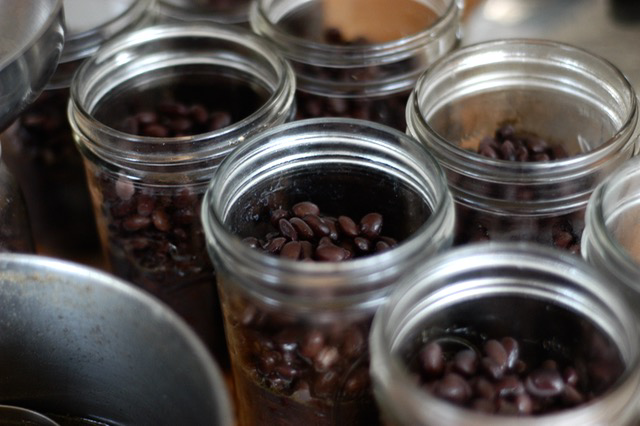
Fill your jars. To ensure that I get the right proportions of beans to broth I strain my beans out of the bean cooking broth with a ladle and divide them among my jars as show below. Then I top off with the seasoned bean cooking water, dividing it evenly between all jars. If needed add additional broth or water to fill jars to 1" below rim. Add a small piece of kombu to each jar if using. (1" x 2" is adequate.)

Dip a cotton cloth or paper towel in white vinegar and wipe the rim of your jars. This will ensure a clean rim and a good seal. You can also use water but I'm partial to the vinegar trick.

Top your jars with lids and screw on rings "finger tight". (If you are unsure how tight that is simply tighten the rings fully, the loosen approximately 1/2".

How to pressure can dry beans : : www.lusaorganics.typepad.com : : Clean

Meanwhile, heat approximately 3" – 4" of water in your pressure canner. (Unlike a water bath canner you don't submerge your jars fully in a pressure canner. The steam pressure does the work this time, not the simmering water.) Add a splash of vinegar if you have hard water to prevent minerals from coating the outside of your jars.

When your jars are lidded and the canner is simmering, it's time to load up! Affix the lid on your canner but don't engage your weight yet.

Watch your canner. When a plume of steam escapes from the valve set a timer for 10 minutes. Keep the heat on under your canner. (Waiting for the steam plume to start in earnest can take an additional 5 – 15 minutes.)

When your timer goes off it's time to apply the pressure! Set your weight to 10 lbs of pressure. Keep the heat on and when the weight begins to rattle set your timer. How long you maintain pressure depends on your jar sizes:

Quarts: 1 and 1/2 hours

Pints: 75 minutes

I always adjust the heat so that my weight is rattling on and off every twenty seconds or so rather than a constant rattle that makes me think my pressure canner might explode at any moment. You don't want long gaps between rattles, but five to thirty seconds is great.)

When your timer goes off turn off the burner. Don't you open the canner! Don't even try. And don't quick-cool the lid by draping a damp towel over it. Just leave it be. Seriously. Otherwise you're fixing for an exploding broth disaster. For. Real. Leave the weight in place as well.

Allow your canner to cool for 45 minutes or more, then remove the weight and carefully remove the lid

How to pressure can dry beans : : www.lusaorganics.typepad.com : : Clean

Use a jar lifted to carefully remove your jars and place them on a towel to cool. 

If you are using Tattler BPA-free lids, then using a hot pad for each hand, tighten your rings and allow the jars to cool for four hours. If you are using regular lids, simply remove and leave the lids be.


After four hours check that your lids have sealed by pushing down on the center of the lid. If the lid is sucked down it is sealed. If not transfer to the fridge and use within a week or transfer to wide-mouth pints filled 3/4 full and freeze.

Allow the sealed jars to sit undisturbed for 12 hours.

After 12 hours remove rings, double-check that the lids are tightly sealed, label and transfer to your pantry.


Herbal Chai Recipe

Perfect homemade chai. (recipe!) | Clean.

Perfect homemade chai. (recipe!) | Clean.

Perfect homemade chai. (recipe!) | Clean.

Some time ago I shared my old nettle chai recipe with you. And really, it's good. So good.

But since that time I have continued to tweak and refine the recipe, week after week.

Like so many things, cooking – and yes, simply making tea – is a living process around here. And where that recipe is at now – well, that old version just can't hold a candle to it.

So I jotted down my latest recipe for you. The changes are minor – just four new ingredients. But to drink it is to love it. As in seriously obsessively love it.

It's crazy good.

This newest incarnation of chai is spicy and sassy and sweet and amazing.

And caffeine-free to boot without feeling like something was forgotten. I loved the nettle version I shared with you before, but it always felt just a little too thin to me. I knew the black tea wasn't there. But this version? You won't even miss it.

That being said, you can also throw in up to six black tea bags to make yours with a caffienated kick. If I'm jonsing for caffeine I'll often make the whole pot without, then add a single tea bag to my cup. Then the kids can enjoy from the pot and I can have a little jolt at the same time.

What is different from last recipe?

Here are the four magical tweaks:

Perfect homemade chai. (recipe!) | Clean.

1. Rooibos

When I cut out the black tea I really missed the dark richness that it gave. The mouth feel of black tea. And no matter what I added I just couldn't reproduce that. Until I tried rooibos. Rooibos is herbal but has the dark richness and thicker mojo of black tea, without the cranky jitters.

2. Star anise

Lupine would tell you it's cute (always helpful in a spice) and she's working on hot gluing one she swiped from my spice cabinet to a barrette. I'm more interested in the smooth, floral edge it lends. Of all four tweaks this is the most subtle, so if you are out of star anise charge forth without it. I add one to a large pot of chai.

Perfect homemade chai. (recipe!) | Clean.

3. Chili powder

Holymoses. I don't know what compelled me to first put chili powder in my tea. (Truly. I have absolutely. No. Idea.)

But since the first morning I did I don't think I've skipped a day. It's surreal how transcendentally good even a humble cup of black or red tea is with a pinch of chili powder. (My standard morning tea is now a cup of black tea with a pinch of ground ginger and a pinch of chili powder.)

And in chai? It's spicy heaven. If you are terrified of spice start slowly but if you are feeling brave add a decent pinch. Good morning!

It's freaking fantastic I tell you.

Do be sure your chili powder is just ground chilies. We don't want salt or funny chili seasoning blend in our tea.

Perfect homemade chai. (recipe!) | Clean.

4. Coconut sugar

Oh, coconut sugar. Where have you been all my life?

We long ago gave up refined sugar of all types. (Except that type in that hidden pint of ice cream in the back of the freezer. Shhhh…) When we began to eat more Paleo foods we discovered coconut sugar in lots of recipes.

And unlike agave's tarnished reputation and recent fall from hippie food glory, coconut sugar is clean. We reach for it often because it doesn't jack your blood sugar. (A good thing for lots of health reasons. Please don't bring up that ice cream.) It's also easy on your gut and has a more subtle flavor than honey, maple, or stevia in recipes. 

But enough chatter. Let's get on to the recipe, shall we?

Are you ready? Because if you are, know that you'll want this every day. Consider yourself warned.

Perfect homemade chai. (recipe!) | Clean.

Perfect homemade chai. (recipe!) | Clean.

Perfect homemade chai. (recipe!) | Clean.

Perfect homemade chai. (recipe!) | Clean.

Rooibos-Nettle Chai

2 tsp Cardamon seeds or 2 T cardamon pods (ideally crushed with a mortar and pestle but whole works okay too if your lack of a spice grinder would stop you)

1/2 tsp whole peppercorns

Scant 1/2 tsp cloves

1" x 2" piece of fresh ginger, sliced thin or smashed with the butt end of a knife handle (or substitute 1 scant tsp dried ginger)

1 star anise

1-2 cinnamon sticks or 1 Tb cinnamon bark chips

1/4 tsp chili powder or 1 small whole dried chile

1/2 cup dried nettle

1/3 cup raspberry leaf

1/4 cup rooibos tea

coconut sugar to taste (1-3 tsp per cup, approximately)

milk of your choice (I use raw cow milk but it's outstanding with homemade coconut-almond milk as well.)

Perfect homemade chai. (recipe!) | Clean.

Perfect homemade chai. (recipe!) | Clean.

Bring 6 cups water to a boil with the spices. Cover and simmer for 5 to 25 minutes, depending on how spicy you like your chai.

Add nettle, raspberry leaf, and rooibos. (Note: While both nettle and raspberry leaf are safe, healthful herbs, nettle can be a bit drying to your system. In the winter feel free to leave it out if you are feeling dry. I add it because I appreciate the minerals. Listen to your body on this one if you drink it often.)

Remove from heat and steep covered for 15 minutes. 

Strain out and compost your herbs. (Or if you simmered your spices for a shorter amount of time, strain out the first batch of chai, then add 4 cups of water to the herbs, simmer covered for 10 minutes, and then remove from heat. Let it steep all day. You'll have a second batch of chai that's almost as good as the first for no additional effort.)

Transfer your chai infusion to a glass jar and store in the fridge for up to a week.

To drink, combine 3 parts chai with 2 parts milk or whatever proportions your palate dictates. Warm and sweeten with coconut sugar to taste (also lovely is half coconut sugar and half honey, or just honey if you don't have coconut sugar on hand).

Drink and enjoy, and wonder how you ever lived a day without this chai.

Love,
Rachel

Originally posted in 2013.


Foolproof thick homemade yogurt

Making thick, delicious yogurt is a simple, rewarding kitchen project.

In five simple (anyone-can-do-it) steps you can transform fresh milk into the most thick, delicious probiotic yogurt you've ever tasted.

But not all homemade yogurt is thick, right? I've made disappointing pourable yogurt before, and truly it's just not the same as a good, thick jar of homemade.

The tips below will walk you though how to make hold-that-jar-upside-down thick yogurt that you and your family will love.

Foolproof (thick!) Homemade Yogurt : : www.lusaorganics.typepad.com : : Clean

Foolproof (thick!) Homemade Yogurt : : www.lusaorganics.typepad.com : : Clean

Foolproof (thick!) Homemade Yogurt : : www.lusaorganics.typepad.com : : Clean

Foolproof (thick!) Homemade Yogurt : : www.lusaorganics.typepad.com : : Clean

Yogurt-making is simple and rewarding. It requires no special equipment and results in a delicious product you're sure to love.

And fresher yogurt means fresher cultures, so more probiotic power for your gut. (Plus it costs far less than the stuff in the plastic tubs, and creates less waste.)

Winning.

Here's how we do it around here, including tips to make your yogurt as thick as the best store-bought variety.

Foolproof (thick!) Homemade Yogurt : : www.lusaorganics.typepad.com : : Clean

Foolproof (thick!) Homemade Yogurt

Ingredients (for 1 quart of yogurt)

1 quart milk (whole organic milk is best, but feel free to use what you have. Also cow or goat, raw of pasteurized – all will work.)

1 Tb yogurt starter (details on lively yogurt cultures are below)

Supplies

Choose one: cooler, oven, heating pad or yogurt maker (I will explain how to use each option)

Kitchen thermometer (optional)

Foolproof (thick!) Homemade Yogurt : : www.lusaorganics.typepad.com : : Clean

Foolproof (thick!) Homemade Yogurt : : www.lusaorganics.typepad.com : : Clean

Step 1: Heat milk

Warm 1 Qt of milk over medium-low heat until it is below a simmer but piping hot (180 F/82 C if you are using a thermometer). A skin will form on the surface of the milk. Lift it off with as spoon and discard.

Thick Yogurt Tip: (Optional) Turn your burner to the lowest possible setting (keep it just below a simmer if you can) and keep your milk warming for 1 – 2 hours. This will evaporate some of the water and result in thicker yogurt! Remove skin periodically as it forms on the surface of the milk so that the water can evaporate. I don't always do this, but on occasion I do and it makes for crazy-thick yogurt.

Edited to add: if you are going to do the longer heating time, add an extra 1/2 pint of milk at the start as you will lose some volume due to evaporation.

Step 2: Allow to cool

Carefully transfer your still hot (but not jar-breakingly hot) milk to a clean glass jar. (I do this little by little to ensure I don't crack my jar, allowing the glass to warm slowly.) Alternatively, allow the milk to cool in the pan and pour into sterilized jars. Cool milk until it reaches 108 F/42 C. If you don't have a thermometer, simply cool until the jar is warm to the touch but not hot.

Adding your culture to hot yogurt will kill your culture, so don't hurry this step. Remove any skins that have formed on the milk using a clean spoon.

(My kids love the idea of the single serving yogurts they see at the coop, so sometimes I divide the batch up between a few pint and half pint jars for them. Any size jar will work.)

Thick Yogurt Tip:(Important!) Sterilized jars are key! Stray bacteria in your jars can upset the balance of your yogurt culture and result in thinner yogurt. Clean jars are a must.

Foolproof (thick!) Homemade Yogurt : : www.lusaorganics.typepad.com : : Clean

Foolproof (thick!) Homemade Yogurt : : www.lusaorganics.typepad.com : : Clean

Foolproof (thick!) Homemade Yogurt : : www.lusaorganics.typepad.com : : Clean

Step 3: Culture

Add 1 Tb of unsweetened live yogurt to your quart. (If you divided into smaller jars, then divide your culture between those jars proportionally.)

Thick yogurt tip: (Important!) More is not better. Indeed, adding extra culture will result in thinner yogurt. I know. It's counter-intuitive. But it's true! Add just 1 Tb per quart and your yogurt will be as thick as can be.

A lively culture is a must! If you following all of my instructions and tips to the letter and manage to have your yogurt "flop" a sad culture is the likely cause.

 
Where should you source your culture? A good, fresh store-bought yogurt is a great option. (Check the shelves at your local food coop to see if there is something made nearby. If not, experiment. Mainstream brands we've had good luck with are Seven Stars, and Brown Cow. Be sure to choose an unsweetened variety as the sugar weakens the culture.
 
If you're ready to take your yogurt making to the next level, purchase a yogurt starter. This variety results in the thickest yogurt I have ever made. We love it.
Thick yogurt tip: (Important!) Be gentle about it! Don't vigorously stir in your culture. You want to baby it. If there are little blobs of yogurt floating on the surface after you stir that's a-ok. I usually press my culture against the jar with the back of my spoon, then give a very slow, gentle stir or two and call it done.

Step 4: Insulate

For the culture to work its magic, you need to keep it warm! This is the second likely culprit if your yogurt doesn't turn out.

Your goal is to keep your yogurt as warm as you would keep rising bread dough. Too cold and the starter won't take. Too hot and you'll kill it. The sweet spot is around 105 F/40 C. A little lower is okay, but don't go higher than that.

Choose one of these places to cozy up your jars:

A. A cooler filled part-way with very warm water.

A simple low-tech option. Place your jars in a small cooler, then fill with very warm/almost hot water to the neck of the jars. Cover and drape with a towel to add insulation. Check the water temp a couple of times. If cooling down, carefully scoop some out and replace with hot.

B. A warm oven.

If you have a pilot light or a "proof" setting on your oven, this can work to keep your yogurt warm, too. (If your oven gets a bit too hot you may have to crack the door.)

C. A yogurt maker.

A yogurt maker adds heat and insulates to keep your yogurt warm while it cultures. I have one. I like it. But often I still use the cooler or oven when I'm doing a larger batch.

Edited to add: since I wrote this post we moved to a house with an oven that is "meh" for making yogurt. Now I make it one jar at a time in a yogurt maker similar to this one. (afflink) I like that my yogurt is still in glass (versus plastic) and I just make a habit of making it more often. If you like having smaller jars on hand, we had one similar to this (afflink) and it worked well, too.

D. Heating pad on low heat.

This can be tricky if your heating pad gets too hot, but can work beautifully. Place heating pat in the bottom of a cooler and cover with a thick towel. Set heat to low and place yogurt on top. Cover.

Let your yogurt culture undisturbed for 4 – 12 hours. Four makes for mild, thick yogurt and the full 12 hours creates a more sour yogurt with no residual milk sugars – great for people sensitive to such things. (And legal for those on the Specific Carbohydrate Diet and GAPS.)

To determine if your yogurt is ready, gently tip the jar a bit to one side. If it is still watery keep it insulated for the longer time. If it looks thick you're set.

Thick yogurt tip: (Important!) Do not disturb. Move those jars carefully. Be sure you don't jostle or stir your yogurt while it cultures or the result will be thin and disappointing yogurt with the whey separating out. Boo.

Foolproof (thick!) Homemade Yogurt : : www.lusaorganics.typepad.com : : Clean
Step 5: Chill

Carefully remove your jars, lid, and transfer to the fridge to cool. While it's hard to wait, if you scoop your yogurt out now it won't be thick! Cool completely before digging in. This is an important final step to thick yogurt!

(Step 6: Enjoy!)

Be sure to save a tablespoon of fresh homemade yogurt for your next batch. You can re-culture from your own yogurt for several weeks (or even months) before needing a new starter. When your yogurt become thin, excessively sour, or persnickety it's time for a fresh culture.

Also, did you notice that I didn't sweeten my yogurt? You can do that if you choose when it's time to eat. But the less time your yogurt is mingling with the sweetener the better. Sugar jacks up those probiotic cultures and weakens them a bit. So sweeten later. If you're traveling with yogurt you can pour a little maple right on top, then stir it in when it's time to eat. 

Happy yogurt-making, friends. Do report back with how it goes, won't you?

Love,
Rachel


Follow my blog with Bloglovin

Get well soon! {A cold and flu season recipe round-up}

I had every intention of being productive today. I even set an alarm. (Something I've only done a handful of times in the past decade.) And, well, a solid two hours after my alarm went off I finally stumbled out of bed to attempt to start my day.

Uffda.

The holiday season is funny that way, isn't it? We race into it head-long at full speed and are spat out at the other end tired, disoriented, overfed, and sometimes sick. As for me, I was doing great until Christmas day. But after our last family celebration was wrapping up I noticed my ear had started aching and I was irrationally tired. I knew what was coming.

I suspect I'm not the only one. The pre-holiday hustle, the stress of travel, our questionable food choices, and a string of late nights leaves our immune system depleted.

No wonder so many of us are feeling run down right now.

And so I thought I would share with you what my method had been to bounce back, in hopes that it might help some of you come out from under your early winter bug as well.

Grab some tea, snuggle under your favorite quilt and read on!

Get well soon! {A cold and flu season recipe round-up} Clean. www.lusaorganics.typepad.com

Get Well Soon! Five simple steps to feeling better fast.

1. Rest

Lots and lots of rest.

That means falling asleep early and staying in bed as late as you can. It means taking it easy during the day. (I haven't thrown a hay bale since Christmas and won't until probably tomorrow.)

For me, a comfy chair, quilt, and basket of knitting beside the fire helps. A lot.

Get well soon! {A cold and flu season recipe round-up} Clean. www.lusaorganics.typepad.com

2. Chicken Broth/Stock

I have been sipping cups of bone broth for days on end. It's my magic potion for getting well in a hurry.

My basic recipe is can be found here. (And no need to pressure can! You can keep it in the freezer if that's more your speed.)

Get well soon! {A cold and flu season recipe round-up} Clean. www.lusaorganics.typepad.com

3. Herbal tinctures

I think simple, homemade tinctures are the best medicines of all. Our family makes many different kinds each season and we rely on them throughout out the year to support our health. Currently I am taking elderberry, echinacea (my recipe is from this booklet), and astragalus tinctures.

If you haven't made tinctures before you won't believe how simple it can be! My recipe and instructions for homemade elderberry tincture can be found here.

Also yes, I give alcohol-based tinctures to children. A single child-sized dose of tincture contains less alcohol than a ripe banana. So I simply don't fret about it.

Get well soon! {A cold and flu season recipe round-up} Clean. www.lusaorganics.typepad.com

4. Stay hydrated

Warm drinks are key. Herbal tea and hot toddys are my top picks to deliver good medicine while helping us stay hydrated.

My hot toddy recipe – with variations from the most simple to more complex – can be found right over here. If you're choosing a purchased herbal tea blend, find one to match your symptoms. (There are teas for a plethora of conditions. We love the Traditional Medicinals brand.)

  Get well soon! {A cold and flu season recipe round-up} Clean. www.lusaorganics.typepad.com

5. Treat your symptoms

Body aches? Epsom salt baths and arnica muscle rub/massage oil both work magic on soreness. Also try a hot water bottle tucked up against an aching back or sore neck.

Earache? You can't beat garlic ear oil. I shared this recipe years ago (along with a few other holistic earache remedies), though the one I used this weekend I made with garlic and mullein flowers.

If you'd like I will share a recipe for it during the next mullein flower season. Do let me know if that interests you!

Get well soon! {A cold and flu season recipe round-up} Clean. www.lusaorganics.typepad.com

Sore Throat? Those toddies work wonders; so does gargling hot salt water. My preferred remedy for sore throat is homemade Monarda tonic. Made with just wild bee balm, raw honey, and brandy it soothes sore throats in a hurry. (I will bring you a recipe during next summer's Wonderfully Wild series and link here when it's available.)

Fever? Try Belladona 12 c homeopathic remedy. This along with our homemade fever tea and the other wellness steps above are our best defense. To make the tea, combine equal arts dried elder flowers, catnip, and peppermint leaf.

We keep a jar of this blend on hand just for fevers.

Get well soon! {A cold and flu season recipe round-up} Clean. www.lusaorganics.typepad.com

Cough? I can't sing the praises of this remedy enough. If you don't have elecampane on hand I urge you to pick some up now and have this remedy ready for your next round of coughs. It works like magic. I also shared two herbal cough syrup recipes in the Herbal Apothecary booklet, one for day and one for night. Both are simple to make and work wonders on persistent coughs. (All proceeds from Herbal Apothecary sales are currently being donated to ease the crisis of Syrian refugees.)

And with that, I have a cozy spot next to the fire that's calling me.

Rest up, friends. Get well soon!


Love,
Rachel


Homemade thick eggnog (refined sugar-free!)

Goodness, has it really been four years since I first shared this recipe? Well, it a good one. This is one recipe I turn to year after year, one that for Sage anyway signals the start of the holiday season. He requests it often, but especially when we're busy with anything that feels even remotely celebratory.

(Since I originally published this recipe, Lupine has stopped eating eggs and dairy due to food sensitivities. We'll be trying this vegan recipe for her this season so that we all can enjoy a mug of eggnog together. I hope she loves it as much as we love the recipe below.)

My (not at all vegan) recipe follows!

(Crazy good) thick homemade eggnog | Clean.

(Crazy good) thick homemade eggnog | Clean.

If you prefer a thinner eggnog you can make the recipe below without cooking (if you are comfortable with raw eggs) or omit the extra yolks.

Thick Homemade Eggnog Recipe

4 C whole milk (mine is raw, but as you will cook it use what you have)

1 1/2 tsp freshly grated nutmeg

2 eggs and 3 yolks (best eggs = best eggnog)

Maple syrup or honey, to taste. (Start with as little at 3 Tb. per batch. Purchased nog comes in in the 6+ Tb range. We love ours far less sweet with just 3-4 Tb, but if you are adding alcohol – or have a sweet tooth – a bit more sweetness may be preferable.)

1 1/2 tsp vanilla extract

How To Make Eggnog

Gently heat milk and nutmeg to very hot but not boiling.

In a separate, heat-proof bowl, whisk eggs and yolks together. Set aside.

When milk is steaming hot temper eggs by adding hot milk 1 Tb at a time and quickly whisk in. Repeat this process until you've whisked 1/4 cup of milk or so into your eggs. (This process keeps your eggs from turning scrambled when you add them to the hot milk.)

Add eggs to hot milk and whisk. Heat over medium heat until the nog begins to bubble and thicken, whisking all the while. Remove from heat, cool a bit, then add maple or honey and vanilla.

Allow to cool to a good drinkable temperature, then puree with your stick blender or regular blender or pour through a strainer if you prefer a perfectly smooth and thick eggnog. Or just drink it up if you aren't particular about these things.

It'll be gone in ten minutes. I promise.


Originally published in 2011.


The best crackers ever (grain-free, vegan, GF, EF, DF)

When we ate bread the rhythm of baking up a couple of big, hearty loaves each week was such a comfort.
 
But we rarely bake anymore. Occasionally Sage will bake a glorious loaf of white bread (gasp!) and then Lupine and I will pull out the gluten-free vegan bread book and make a loaf for us, too, but seriously. Bread is a rare treat over here.
 
But crackers? We love crackers. We crave them. Good crackers can turn leftovers or some paltry cheese and meat into a satisfying lunch. Good crackers can take a blah salmon salad and transform it into a favorite lunch.
 
I originally shared these recipes with you in 2014. And since then I have fallen out of the habit of making them and have started to miss them terribly. As of today? I'm back in the game. Enjoy!

gluten-free, grain-free cracker recipes| Clean. www.lusaorganics.typepad.com

gluten-free, grain-free cracker recipes| Clean. www.lusaorganics.typepad.com

gluten-free, grain-free cracker recipes| Clean. www.lusaorganics.typepad.com

gluten-free, grain-free cracker recipes| Clean. www.lusaorganics.typepad.com

A couple of weeks ago I told you I wouldn't be sharing recipes any time soon. Less than an hour later two batches of crackers were coming out of the oven and my entire family was swooning, lost in grain-free crispy cracker bliss.

We've made them a couple of times a week ever since.

These crackers are easy to make. Delicious to devour. And crazy affordable compared to crackers from the coop or the grocery store.

Oh, and healthy. I think I'm supposed to tell you they are healthy. Yes. That, too.

Feel free to modify the recipe with your favorite seasonings, spices and seeds. I'm thinking garlic & sesame, onion & poppy seed, or chili-powder & lime. Ooh, and maybe pistachio something…

Oh, mercy. This could get out of hand.

The secret, sweet friends, is tapioca flour. Do you bake with tapioca flour? Along with almond and coconut flour these three are the power triangle of grain-free baking. Tapioca flour, however, is my favorite of the three. It's a little piece of heaven in a Bob's Red Mill bag.

Are you ready to have your grain-free, gluten-free cracker-loving mind blown?

Well here you go.

One recipe is grain-free, gluten-free, and nut-free; the other is grain-free, gluten-free, egg-free, dairy-free, and vegan. (There I go, trying to make everyone happy again.)

This time though I think it might have worked.

gluten-free, grain-free cracker recipes| Clean. www.lusaorganics.typepad.com

Parmesan Crisps

These crackers are super crisp and snappy. There were everyone's favorite (except mine) by a large margin. As a mother I love each recipe for different qualities but I love them equally. (Okay, okay. They're my favorite, too. But only by a little.)

Be sure to roll them out very thin for a crispy cracker. If you don't they'll be a little gooey in the middle.

* I've hidden the leftovers from the third and fourth batch of these I made today from my children. And yes, also from Pete.

gluten-free, grain-free cracker recipes| Clean. www.lusaorganics.typepad.com

Ingredients

3/4 C tapioca flour

1/2 C grated Parmesan cheese (1/4 c packed Parmesan)

3 Tb ground flax seeds (I grind mine in an old coffee mill)

1/2 tsp salt

3 Tb water

2 Tb cream (alternatively you can omit water and cream and add 5 Tb whole milk)

1 Tb olive oil

Process

Preheat oven to 325.

Combine all ingredients except liquids (water, cream, and oil) in your food processor. Pulse a few times to combine.

Add liquid ingredients and process until thoroughly combine and looking crumbly but most.

Open up your food processor and pinch a small handful together in a ball. If it holds together then you're good to go.

If it's too dry and crumbles apart add additional water 1 tsp at a time. If it's very wet and sticky add additional tapioca flour 1 tsp at a time.

Turn out onto a sheet of parchment paper, form into a ball, and flatten.

gluten-free, grain-free cracker recipes| Clean. www.lusaorganics.typepad.com

Roll out very thin (as thinly as you can!) and then cut into cracker shapes with a pizza cutter or knife. Keep your crackers under 2.5" across, otherwise they tend to be sticky in the middle. If your dough is unruly you can roll it out between two sheets of parchment. I don't find it necessary, but just in case.

Bake for 20 – 25 minutes, remove from oven, and cool on a cooling rack.

In the unlikely event that you have leftovers, store them in an airtight container. 

gluten-free, grain-free cracker recipes| Clean. www.lusaorganics.typepad.com

Paleo Sesame Seed Crackers (vegan)

Think shortbread minus the sweet. Tender crisp, crumbly, and rich. I have a vague recollection that this is what a Wheat Thin felt like as it crunched between my teeth. But I might be wrong. It's been a long time.

These crackers are crisp and nutty with a tender crumb. So good. If you love sesame you'll lose your mind.

Ingredients

3/4 C tapioca flour

2 Tb coconut flour

1/4 c almond flour

2 Tb sesame seeds

2 Tb ground flax seeds

generous 1/2 tsp salt

3 Tb olive oil

3 Tb water + more as needed

Process

Preheat oven to 350.

Combine all ingredients except water and oil in your food processor. Pulse a few times to combine.

Add liquid ingredients and process until thoroughly combine and looking crumbly but most.

gluten-free, grain-free cracker recipes| Clean. www.lusaorganics.typepad.com

Open up your food processor and pinch a small handful together in a ball. It should hold together easily without being sticky. (If it's too dry and crumbles apart add additional water 1 tsp at a time. If it's very wet and sticky add additional tapioca flour 1 tsp at a time.)

Turn out onto a sheet of parchment paper and form into a ball. Let rest for five minutes.

Flatten out dough and roll out between two sheets of parchment.

Cut into cracker shapes with a pizza cutter or knife.

Bake for 15 – 20 minutes, remove from oven, and cool on a cooling rack.

In the unlikely event that you have leftovers, store them in an airtight container.

I saved the recipes as a PDF here for easier printing. Enjoy!

Download Grain-freeCrackerRecipes-twoways

Inspiration for these recipes came from here and here

Out of baking powder? Make your own!

How to make baking powder

How to make baking powder

Maybe you already know this and I'm just bringing you some stale old news. But for years and years I have been buying baking powder and then feeling a little vulnerable when I was running low.

But then when we were grain-free I discovered that it's easy-peasy to make at home. And it's been a solid five years since we purchased the stuff. It's a great option if someone if your family has food allergies or sensitivities, too, since you're in control of the starch that goes in.


All you need is baking soda, cream of tartar, and starch of your choice (I use tapioca).

The instructions below might just save you from a pre-holiday cooking marathon freak out.

Here's how:

How to make baking powder

Homemade Baking Powder Recipe (corn-free option)

2 parts cream of tartar

1 part baking soda

1 part tapioca starch (or arrowroot or corn starch)


Combine ingredients using the ratios above, sift and place in a labeled glass jar. (Since cream of tartar comes in those teensy little canisters I normally start by measuring what we have of that and working my way out from there.)

And… you're done.


You're welcome! Happy baking.