Homemade playdough recipe.

Homemade playdough Recipe | Clean : : The LuSa Organics Blog

There are few projects as satisfying to a five-year old (okay, or even a 35 year-old) as making playdough. It's fast, simple, and rewarding beyond the skills needed to make it happen.

I shared my playdough recipe once before, but I've rewritten it for you now, with photos of the process. Those help, since playdough goes through a "that-can't-be-right" stage just before it's done.

A note on wheat: though we do not eat gluten, no one in my home is celiac so this recipe is based on wheat flour. I'm working on a gluten-free version that I'll be sure to share when it's ready.

Homemade Play Dough

1 C white flour (I have used whole grain with good results as well)

1/4 C salt

2 T cream of tartar

1 C water

2 tsp food coloring (optional)

1 Tb oil

A few drops of essential oils of your choice.I am partial to Cranky Pants EO Blend, but use whatever you love.

Homemade playdough Recipe | Clean : : The LuSa Organics Blog

Homemade playdough Recipe | Clean : : The LuSa Organics Blog

Homemade playdough Recipe | Clean : : The LuSa Organics Blog

Combine dry ingredients in a medium cooking pot.

Add wet ingredients (except essential oils) and stir.


Homemade playdough Recipe | Clean : : The LuSa Organics Blog

Cook
over medium heat stirring constantly. It will go through the following stages:

Homemade playdough Recipe | Clean : : The LuSa Organics Blog

Wet soupy flour mixture;

Homemade playdough Recipe | Clean : : The LuSa Organics Blog

still moist but becoming gooey and starting to stick to the pan;

Homemade playdough Recipe | Clean : : The LuSa Organics Blog

very awkward to stir and rather chunky;

Homemade playdough Recipe | Clean : : The LuSa Organics Blog

and then suddenly – voila! – a fairly smooth ball of dough in your pot.

Homemade playdough Recipe | Clean : : The LuSa Organics Blog

Once the dough forms a ball in the center of the pot, turn
out onto a lightly floured surface. Allow to cool for a few minutes, then knead until smooth. Make a dent with your finger to add optional essential oils. Knead in completely. 

Homemade playdough Recipe | Clean : : The LuSa Organics Blog

For colored dough, divide as desired. Flatten each ball and make a fingerprint in the center. (But don't go all the way through!)

Add a drop or two of food coloring to each, then fold into a little calzone and carefully knead and fold to work the color into the dough. (This job is best for adults or older kids, and you might want to wear gloves if you are worried about a touch of coloring on your hands.)

We've had success with both grocery-store food coloring and the natural food coloring we use for baking.

Homemade playdough Recipe | Clean : : The LuSa Organics Blog

Store in the fridge. Discard when it becomes sticky or if it starts to seem off.

Want a PDF of the recipe to can print it out? You bet!

Download HomemadePlaydoughRecipe

Have fun today!

Love,
Rachel

Foolproof Canned Pickle Recipe

I feel some days like there is so much to share with you. So much going on. And yet, where to begin? Part of me wants to start by telling you about the rain that finally fell last night and how worried this drought has had me feeling. Part of me wants to tell you about the swimming hole we just discovered, the kale going wild in the garden, the farm we are contemplating, or the visit from my sister-in-law.

Part of me wants to share a variety of stories – some heavy on my heart and others warm in my soul – but then there is that bushel of cucumbers on the kitchen counter, demanding that I tend to it.

Produce is good that way. It keeps us in the now. So we'll start with pickles. Because the cucumbers just won't wait.

DSC_4118

How to Make Canned Pickles

If you have never canned before, pickles are a good place to start. They are simple, require few ingredients, and the product is outstanding. (Really. These will blow your mind.)

If you are interested I will share how to make live-fermented sour pickles next week. But for storage, canned pickles keep beautifully all year long.

DSC_4139

DSC_4130

DSC_4133

DSC_4117

Gather your supplies.

You will need:

A hot water bath canner. (I am using a pressure canner but not pressurizing it because it's all I have. We'll be hot water bath canning, which in a pinch can be done in a stock pot!)

Canning jars and lids. Check Craigslist and garage sales if you have the time or pick them up at the grocery or hardware store. My lids are Tattler lids because I am more comfortable with them as they are BPA-free but use what you have. Do remember that you need new metal lidsfor every batch. (Used rings, free of dents and rust are fine.)

Salt. Most recipes call for "canning salt" but mineral salt or sea salt works perfectly and provides minerals as well. Just stay away from salt with added iodine. Also know that if you use mineral salt you'll have some clouding in your jars (to which I say, "Who cares?").

Vinegar. While most recipes call for white vinegar I love apple cider vinegar for pickles. This time I did half of each since I was a little low on both. (I just refrained from making a joke about being "in a pickle becasue I was low on vinegar". Sorry. I couldn't resist.) The message is: use what you have. Any 5% acid vinegar will work.

Cucumbers, of course. You can pickle all manner of firm vegetables but we're starting with the basics. Cucumber pickles made by this recipe will become your addiction. We ate through a double batch of these by February last year, so I made a quadruple batch this time. I just hope they last.

DSC_4144

Prepare to Can!

Soak your cukes. Unless you just picked them moments ago, submerge your cucumbers in ice water to rehydrate them. You can soak them overnight or just for an hour. It's up to you. Your pickles will be better for it, but if you are in a time pinch don't fret – just skip to the next step.

Wash and sterilize your jars. Yeah, I hate washing clean jars too. If they are in my kitchen cabinet I don't bother but jars from the basement need a quick wash. Fill your canner with enough water to cover your jars. Bring to almost a simmer, then submerge your jars. Bring to a boil, turn off heat, and soak for a few minutes. Remove jars pouring water back into canner.

Sterilize your lids. Bring a small pot of water to boil. Remove from heat and add jar lids, gaskets (if applicable) and rings. Leave in hot water for now.

Cut off the blossom ends of your cucumbers. This is the end with the tiny belly button rather than the wider stem belly button. A friend and reader shared this tip with me last year. There are hormones in here that will soften your pickles over time, so cut that end off by 1/4 or 1/8 inch. Discard.

DSC_4121

DSC_4125

The Recipe: Viroqua Pickles

makes approximately 7 pints

4 lbs (or 1/4 bushel) of cucumbers, preferably small and firm

2 3/4 C vinegar

3 C water

1/4 C salt

7 cloves of garlic

peppercorns

1 bunch of dill

Process

Bring vinegar, water, and salt to a boil. While the brine heats place in each jar 1 clove of garlic, a pinch of peppercorns, and a few springs of dill.

Place whole small pickles or cut larger pickles in the jar. Be mindful to really pack them in, standing spears on end and wiggling as many in as possible.

When the brine comes to a boil pour over cucumbers, leaving 1/2 inch of head-space. (The neck of the jar is more than enough room.) Carefully wipe the rims of your jars with a clean dry cloth.

DSC_4129

DSC_4138

Drain the water off of your lids and rings. Lid the jars being mindful to not over tighten. (I tighten mine and then unscrew them just a touch.) Using canning tongs, lower the jars into the hot water. Add more water if necessary to cover jars with at least 1" of water or remove a bit if your pot is overfilled.

To prevent jar breakage, don't crank the heat! Lid the canner and set heat to medium-low. Allow to come to a simmer. This will take a while, maybe 10 or 20 minutes, depending on the batch.

When the water reaches a slow boil/heavy simmer set your timer. Simmer for 10 minutes for pints and 15 minutes for quarts. Check occasionally to ensure that it's still simmering. If you find it isn't simmering anymore adjust the heat and add a couple of minutes to your time.

DSC_4148

When the timer chimes, remove with tongs and set gently on a towel. Allow to sit undisturbed for one hour, then check your jars. For metal lids, just push down the center to test the seal. If the lid pops down your jar did not seal. Fridge it or attempt to reseal. To reseal, check rim for chips and lid for damages, then reprocess as above. To test the seal on Tattler lids carefully remove rings and gently lift lid. It will come off if the lid failed.

Your pickles are done! Bravo!

I saved the text above as a PDF for you to print out. Have fun with this. You are awesome and so are your pickles.

Viroqua Pickles PDF

Sew a Sunhat.

Hi friends. I want to give my kids my full attention today and not be distracted by time at the computer. With that in mind, I am reposting my sun hat pattern from two summers ago for your enjoyment. Perfect for your little boy or girl, choose their favorite fabric and start stitching! The hat sews up quickly and is fairly easy for even a novice sewer.

If you've made the hat already, I'd love to hear how it turned out!

Have a great day, friends.

Love,
Rachel

~ *~ * ~* ~ * ~
DSC_3396

This is a little late in coming. I promised you this pattern weeks ago! I didn't make the time to stitch up a second one and I didn't want to post it without photos, thus the delay. But summer is wearing on and I have this image in my head of many little boys out in the sun, squinting like mad.

So here it is – a sewing pattern without photos – but a pattern none-the-less. Go forth and sew hats, you brave, bold mamas.

(Note: the hat below seems a bit too tall to me, so the pattern trimmed off about an inch.)

DSC_3375

Sage's Sunhat

Materials:

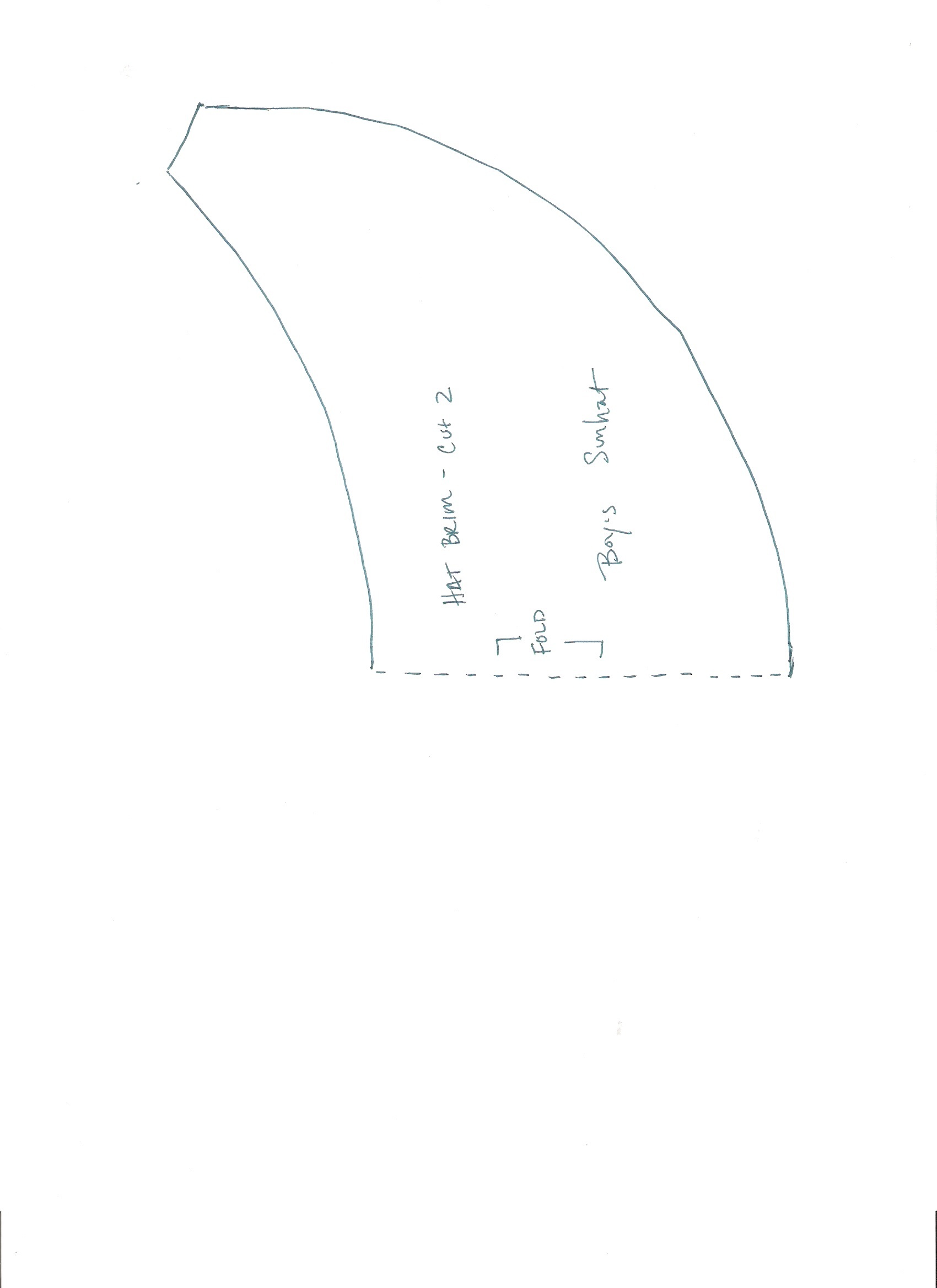
  • Pattern – three pieces (below). Print without scaling so that you get the proper size.
  • Outer fabric (I used linen)
  • Lining fabric (I lined with the same)
  • Timtex or other stiff interfacing for brim
  • Matching thread

All sewing was done with a 1/2 inch seam allowance. This was sized for my 7 1/2 year old. Adjust as needed to fit a younger or older child.

Boy Sunhat Band (No pattern piece. Rectangle 21.5" x 4") – cut two (one lining, one outer fabric)

Boy Sunhat Top Pattern – cut two (one lining, one outer fabric)

Boy Sunhat Brim Pattern – cut three (two outer fabric, one interfacing.) Note: When you cut out your paper pattern fold and cut so you have the entire 1/2 moon. I only copied down 1/2 of the pattern to make it fit on a single sheet.

Brim

  1. Cut interfacing brim down by 1/2 inch on all sides.
  2. Sew outer curved edge of brim, right sides together.
  3. Turn and press.
  4. Insert interfacing and trim if needed to fit smoothly inside.
  5. Top stitch outer curve through all layers to hold interfacing in place.

Crown

  1. Fold hat band so that the short ends line up (right sides together), creating a flattened cylinder.
  2. Sew.
  3. Pin cylinder shape carefully to hat top (also right sides together).
  4. Sew.
  5. Turn right side out and press.
  6. Repeat with lining.
  7. Pin brim to hat, centered opposite of back seam with top side of brim flat against front of hat (it will look like someone flipped the brim up, 1980's grade school style).
  8. Sew into place and flip down. It should be starting to look like a hat now!
  9. Press under 1/2" on bottom edge of hat and hat lining.
  10. Insert hat lining into outer fabric hat and top stitch together very close to the edge. 

DSC_4394

Your hat is done! Dance around a little and then call in your boy (or girl) and share your creation. Feel free to leave comments or send emails with your questions.

xo

Rachel

How to Make Beeswax Luminaries

Welcome! Make yourself cozy and have a look around. Crafy tutorials, fabulous eats, natural parenting musings (like this favorite), and other inspiration abounds. Peace, Rachel

DSC_9011

DSC_8991

Glowing beeswax luminaries. Magical? Heck yeah. Add to that easy, affordable, natural, and DIY and that's my kind of decorating.

It all started with Pinterest. I saw this tutorial for making luminaries with paraffin wax and balloons. And I though: how about beeswax? Beeswax would be warm and sweet and wonderful. So much more alive than paraffin and more "me". Oh, yes. That sounds exceptionally nice.

So with a goal of warm golden globes scattered around our home on New Year's Eve, glowing warmly and scenting the room with the sweetness of summer I dug in. We're having friends over this weekend. Ambiance, anyone? I'm in.

I jotted down a quick tutorial for you, too. If you have some beeswax and balloons you're pretty much set.

DIY Beeswax Luminaries

Supplies

9" balloons

Beeswax (2 lbs or so with plenty left for other projects…)

Double-boiler, slow cooker, or stainless pot

Parchment paper

Process

Fill balloons with warm water. (Or if the only faucet in your house that will take a balloon is cold water only, fill a basin with warmish-hot water and soak your cold balloon's for a while.) Fill them to the size that you want your luminary to be.

DSC_9005

Your balloons should be full enough that they are plump/taught. If you want smaller luminaries, simply knot them off as tightly as possible like the balloon above (note the long "tail"). I say this because I had trouble with under-filled balloon's. The luminary cracked when I set them down to cool, an issue I did not have with full or tied-with-a-long-tail balloons.

Heat your beeswax. Ideally you want it around 160-170F. I do this in a slow cooker that I picked up at a thrift store just for this job. If you don't have a slow cooker you can simply use a cooking pot on low heat or fashion a double boiler out of two pots. (Be prepared to donate the wax pot to wax forever more. Though it is possible – and a bit of a headache – to clean out.)

Melt the wax on high, then turn it to low before you set to work. I only checked the temp twice during a 40 minutes of luminary making and it held temp well. No thermometer? No worries.

Troubleshooting Temperature

If you don't have a thermometer, wing it. Here's how you know you have the right temp:

  • Is the wax sticking smoothly to your balloon? Then it's your temp is good! Dip.
  • Is the wax lumpy? Too cool! Heat it up.
  • Is the wax melting the previous layer off when you re-dip? Too hot! Allow to cool.

DSC_8979

DSC_8983

Dip your balloon repeatedly. Do not dip beyond the water/air line on your balloon. If you wonder why and decide to try it your balloon will dramatically explode, filling your wax pot with water and causing you much grief. (Ask me how I know…)

Every six dips or so gently place the balloon on a piece of parchment paper to flatten the bottom. Let it sit for a bit to cool. Between every dip allow 5-10 seconds for the wax to cool before you immerse it in the wax another time. (I like to do two balloons at a time, alternating between them.)

Random sidebar to answer the question you are asking: that's my dry erase board in the background above. The tutorial for making that is over here.)

DSC_8978

After approximately 20-30 dips, gently place your balloon on the parchment and allow to cool. Your goal is a luminary that is thick enough to hold up to use, yet thin enough to let the light through. Once it feels firm to the touch (though still warm) take your balloon to the sink and pop it! It will startle you every time. I promise. And you will likely get a little wet if your aim is off. Peel away and discard the balloon.

DSC_8997

Trim any ragged edges with a pair of sharp scissors while the luminary is still warm. Then place a tea light or votive (in a cup) inside and enjoy. (The brighter your candle the warmer the glow.)

Happy New Year to you. I'll be back her next week with more treats in store.

Love,
Rachel

How to Make Your Own Fairy Wings.

DIY Fairy Wings | Clean : : the LuSa Organics Blog

DIY Fairy Wings | Clean : : the LuSa Organics Blog

I know, I know. A fairy wing tutorial? On November 1? I'm a day late and a dollar short. Because Halloween was, like, yesterday

Yes. Halloween was yesterday. I woke in the morning with a random plan to be Rollie Fingers for Halloween. (I was a huge Brewer's fan as a kid and this guy's mustache has always been a source of strange fascination for me.) But my own kids were freaked by the idea of their mother in a baseball cap and a wool handlebar mustache. And then I couldn't find my baseball cap and the whole plan unravelled. I had to be something else.

But what? My costume stash is pretty lean these days, consisting of a too-tight-for-me-now wedding dress, a pair of cowboy boots and an Amish straw hat. And that combination was scarier than the mustache, so I needed a plan-B. A fairy! Of course. But Lupine's wings were too small.

I searched Pinterest for ideas and came across two useful tutorials (this one and this one.) I read them each over once, got a little overwhelmed, and just went for it on my own.

And they were so easy. Ridiculous. And because of the amount of glitter I used, extremely satisfying as well. (I don't know what it is about glitter. I wish I could put it on my food I like it so much.)

These wings took me less than two hours from start to finish (including a trip to Walgreen's for nylons when I realized that I simplified all of my tights right out the door last spring).

So easy and so much cuter than a handlebar mustache.

DIY Fairy Wings | Clean : : the LuSa Organics Blog

Here is what you need:

Four metal coat hangers or equivalent amount of other strong wire

Duct or packing tape

2 pairs of tights or nylons, mine were size large-ish and full length, though in retrospect thigh-highs would work great.

Fine glitter

White glue or Mod Podge

DIY Fairy Wings | Clean : : the LuSa Organics Blog

1. Shape each of the four hangers into a wing shape. My top and bottom wings have a slightly different shape giving a distinct top and bottom, but go with whatever you like.

2. Cut off the hooked part of each hanger and tape together your left and right wing pairs, as above.

3. Slip a nylon leg on each wing segment and cut it off at the appropriate length. Knot on the back.

4. Tape together the left and right wings to make a connected set. You're almost done!

DIY Fairy Wings | Clean : : the LuSa Organics Blog

5. Using diluted white glue (1:2 water to glue), paint the edges of your wings and sprinkle with glitter. Paint designs on the wings and add more glitter. Knock extra glitter off onto a tray or newspaper and reuse. Don't rub the glitter into place or you may smear the glue. Allow to dry while you admire your work.

DIY Fairy Wings | Clean : : the LuSa Organics Blog

DIY Fairy Wings | Clean : : the LuSa Organics Blog

Your house. Will be full. Of glitter. But that's okay. Because now your house is magical instead of messy.

6. Hide your packing tape under ribbon or fabric. I simply wound a long piece of velvet ribbon around the center until all of the tape was hidden and secured it with a straight pin. You can do something more permanent but I was under time constraints and didn't want to get glue on my coat. Fabric glue (Tacky Glue or some such) would work well.

7. Attach a super long length of ribbon (the long cream-colored ribbons below) for straps. Cris-cross over your chest and tie in the back or at your side.

Tie them on and say to your reflection, "You are so cute I can hardly stand it. Mwah!"

DIY Fairy Wings | Clean : : the LuSa Organics Blog

Edited to add: if you're looking for other clever costumes, how about this knitted bluebird hat? (Thought I'm a bit partial to the gnome hat…) Or maybe a crown is more your speed.

How To Felt Soap

Welcome to Clean! I frequently post simple craft tutorials as well as share my reflections on gentle parenting. I invite you to like my page on Facebook and keep up on what's happeing here. Peace, Rachel

DSC_6029_2

What is felted soap?
Felted soap is a bar of soap encased in a wool cover. It is soap in a jacket. It is soap with a sweater. It is a built-in washcloth, poof, or scrubbie. And the real magic is that the wool continues to felt up smaller and smaller as the soap shrinks, staying tight around the ever diminishing bar. Cool? Very. And at the end all that remains is a wee scrap of wool that you can toss into the compost. I love that.

It sounds complicated.
No. Not really. As homeschoolers, my family is always looking for a project that is easy enough to satisfy our children but fun enough to be enjoyable for all. Wet felting is one such project. Quick, easy, and affordable, my children and I wet felt beads, paperweights, balls, vessels, soap, and more. Heck, you can wet felt a rock to make a paperweight Martha Stewart would be proud of. All you need is wool (roving), hot and cold water, a little time, and in this case a bar of soap. Each bar takes under five minutes, so you can make dozens in an afternoon.  

Ready to get started?

Good. Me, too.

DSC_6019

DSC_5987_2

Materials

To create felted soap you will need a few ounces of colorful 100% wool roving. Ask at your local yarn shop for a roving that wet felts well, or visit a website like Etsy and search for “roving”. Choose a few coordinating colors.

Soap (obviously). I'm partial to my own soap, and I sell "Imperfect Soap Samplers" (as pictured above) which are perfect for this project at a bargain. But use whatever you love.

Instructions

Begin by filling a soup pot with very cold water (toss in a few ice cubes for good measure). Set the pot aside by your sink.

Roughly measure the width of your soap bar. Tear off a piece of roving that is approximately three times this measurement. This will give you enough wool to wrap your soap with some overlap of the ends. (Don’t cut your roving. Tear with your hands. You may need to tease the roving apart a bit to make it thin enough to tear.) Tease apart the wool until it is a fairly thin and uniform layer. You should be able to see your fingers through the fibers. It if becomes much wider than your soap, pull away the excess and set aside.

DSC_5994

Wrap the bar of soap tightly in the wool, overlapping the ends. Set aside your soap, weighting down the wool with another bar if necessary to keep the wool tight.

DSC_5997

Measure the height of your bar and triple it. Working in the same color or a new color, again tear off a length of wool to wrap your soap in the opposite (vertical) direction. Tease the wool into a thin layer. Repeat vertically the wrapping process on your soap. You should now have a bar of soap completely covered in two layers of wool. Look it over. If there are holes move the wool around a bit to cover any exposed soap.

DSC_5999_2

Holding the wrapped bar carefully, move to the sink. Turn on your hot water tap. When the water is very hot (as hot as you can comfortable place your hands in), set the faucet to a trickle. Take a dab of liquid soap or dish soap and place it in the palm of your hand. Using your fingers on the opposite hand, pick up a small amount of soap and gently work it into the wool on the top of the soap. Repeat on the bottom of the bar.

DSC_6005


Move the wool-covered soap under the trickle of water to just moisten the fibers. (Do not soak the bar). Using a very gentle touch, massage the soap with your fingertips to lather up the liquid soap. Flip the bar over and repeat. When the wool is lathery, move under the hot water again and continue to gently massage the wool. This time the wool will become thoroughly saturated and the bar of soap will begin to lather.. The wool will be squishy and loose on the soap. This is normal. Be gentle. Use patience, a light touch, and go slow.

Continue to massage and lather the soap very gently in your hands. Alternate between the hot tap and gently massaging, then the cold tap and massaging ever minute or so. The combination of friction, hot water, and cold water will case the wool to transform into a dense felt, encasing the soap.

DSC_6006_2

As the wool very gradually becomes more densely felted, you can apply more pressure to speed the felting process. Within a few minutes you will be gently flipping the felted soap in your hands like you are washing up. Continue to alternate between hot, cold, and friction until the wool is fairly tightly felted around the bar. When you are satisfied with the tightness fo the wool, rinse the bar, squeeze out excess moisture and set aside to dry. (The wool will be soapy. Don’t fret. It’ll dry up beautifully.)

DSC_6017

Experiment with single colors, multiple colors, and even needle felted embellishments added after the soap and wool are dry. Happy felting!

How to Make Paper Lanterns.

Sometimes, you create time by bending the rules. Sometimes you change the scenery for a few days and see what unfolds. Lupine and I are off on a mama-daughter adventure. We've never done this before, just the two of us. And we're both so excited we woke up an hour early.

The car is packed. With the necesities. Like colored pencils, felt, scissors, acorn caps, glue, and plenty of knitting (including her own! My baby is a knitter!). We brought tea and books; good food and wool slippers. We'll be back here early next week with a report from the road.

In the meantime, here is a repost for you from last fall. This is the perfect time of year for a lantern walk! This is one of my favorite projects.

See you out there.

Love,
Rachel

DSC_9157

DSC_9150

The days here in the north are growing shorted. By dinner time the outdoors are immersed in complete darkness, and when we wake in the morning the sun is still nowhere to be seen. And the days are growing shorter still.

To celebrate the light that shines within each of us (even during these darkest days) the children and I made paper lanterns and carried them out into the darkness for a bedtime walk. The lanterns represent the brightness we bring to the dark, and the positive effect our bright spirits bring.

DSC_9161

The process of making the lanterns is more simple than you might imagine. We loosely interpreted the pattern for Martinmas lanterns from this lovely book (another recommended read) as our jumping off point. I have shared our version of the lanterns below.

Supplies

Watercolor paints

Watercolor paper (ours is approximately 14" x 20", purchased here)

Ruler

Scissors

Pencil

Craft knife

Cutting mat or board

Kite or tissue paper

Glue stick

White glue

5 spring-type clothespins per lantern

Yarn or wire for handle

Hole punch (optional)

Fireproofing spray (optional)

Instructions

1. Create a simple watercolor painting. Allow to dry completely. (You will have enough paper for two lanterns from each piece of paper.)

DSC_9118

2. On the back of your painting carefully mark the following measurements with pencil and a straight edge:

  • Divide the painting in half with a horizontal line. To simplify, you may cut your paper into these two long thin strip now. (Our strips were 7 1/2" tall and almost 20" long)
  • Parallel to your original cut mark two lines: one 1/2 inch down from the top and a second line 2" up from the bottom. These will form the top lip and the bottom of the lantern.
  • Perpendicular to your original line, begin at the left and measure in 1". Mark line. This will be an overlapping piece used to form the lantern during the final steps of the project.
  • From this 1" mark, measure five 3 1/2" panels and mark. These will be the five window panels.
  • Cut off any excess after your last 3 1/2" panel.

3. Score all lines using a straight edge. (This will make folding your lantern easier.) 

DSC_9108

4. Cut tabs for the top and bottom of your lantern by cutting all lines above and below your two long horizontal lines. (Confused? See two photos below for a visual of where you cut.) These tabs will overlap and form the bottom and the top lip of the lantern when you glue the lantern together.

5. With a pencil, draw the shapes you desire for windows on the back of your paper strip. Think simple forms – circles, stars, even rectangular "windows".

6. Use a craft knife (X-acto type) to carefully cut out the windows.

DSC_9141

7. Flip over your painting and admire your work! Add additional details if desired with hole punch or craft knife. I used a small circular hole punch to embellish ours.

DSC_9113

8. Cut kite paper windows the size of your main panels. Glue into place with glue stick and smooth.

DSC_9129

(Note: the next step requires a teeny bit of patience. At least it did for me. The lantern has a propensity to spring open while you are encouraging it to stay closed. Hang tight! You are almost done, and you are smarter than the glue.)

9. Fold your lantern carefully into shape, creasing each scored line firmly. Observe where the flaps overlap on the top, side, and bottom. Apply a thin layer of white glue on each overlapping point, then refold the lantern pressing the glued panels together. (These will be triangles of glue on one end of each flap.) Be consistent with the end you glue (all on the left, for example) so that you can neatly close one flap after another and end up with a firm secure bottom.

10. Use a clothespin at each overlapping point on the top of the lantern to hold the tabs together until the glue is set. Before the glue is all the way dry remove the clothespins. (This way you don't accidentally tear the lantern when you remove the clips). 

DSC_9138

10. Cover the hole in the bottom of your lantern with a scrap of watercolor paper approximately the size of the base of your lantern. Secure with more glue.

11. Punch two holes in the lantern's top rim and string through some wire or wool yarn. Knot yarn securely and add a tea light candle, securing to the bottom with poster putty (if you, like me, lack poster putty gum will work in a pinch, and adds a minty smell to the whole event.) (One thought: for those of you with young children or a concern of you little one holding a paper box with fire inside, battery powered tea lights are a good choice. I believe that the responsibility of holding a lantern with a candle inside is wonderful for a child, but perhaps that should wait until they are 4 or 5.

12. You are done! Now just wait for nightfall and take your lantern with you to spread a bit of light into the darkness.

DSC_9166

DSC_9148

How to Sew a Fabric Bunting.

DSC_4388

DSC_4467

I wrote a fabric bunting tutorial this summer (for the Saponifier magazine). I wanted to share it with you because who doesn't want one of these? Cute. Handmade. Simple. I use this one at my farmer's market booth but want one for the kids's rooms as well. I also made a more free-form version of a bunting with Sage when he was 4 that we use each year on his birthday. Ready to sew? On with the how-to.

How to Sew a Fabric Bunting

There are no rules for bunting size, spacing, length, or shape. Use my formula below, or just use it as a jumping off point for your own design.

Materials:
Fabric for triangles, of an assorted or single
Fabric for banner tape, 4” wide x your length as determined above
Fabric marking pen
Sewing Machine
Coordinating thread (if the color of your bunting spreads across a wide spectrum, light gray or tan works well for most colors)
Rotary cutter or shears and cutting mat
Straight pins
Measuring tape

Step 1: A Bit of (Easy!) Math

This step is optional, but helpful if you want to know how long your bunting will be. If you don't care, skip the math. If you care, dig in. It'll take you all of two minutes.

First, determine how long you want your bunting to be. To do so, measure the area you want the bunting to span. Add two 24” tails if you want to be able to secure the bunting to something. (like a curtain rod or table leg) and 10” for drape.

For example:

If your banner will span a 6’ (72”) table, you will need:

72” span + 48” tails + 10” drape = 130” length.


Across a 10’ (120”) tent you will need a span of:

120” +48” tails + 10” drape = 178” length.

Second, determine the number of pennants or triangles you need. To find this number, subtract your 48” tails, then divide by 10 (the span of each pennant) and multiply by two (the triangles are two sided).

For example, the 6’ bunting will require:

130” – 48” = 82”/10 x 2 = 16.4. Round up to the nearest even number. For the 6’ bunting we’ll make 18 triangles for 9 pennants.


Across the 10’ span you will need:

174” – 48” = 126/10 x 2 = 25.2. Rounds up to 26 triangles for 13 pennants.

Step 2. Cut Your Triangles

Cutting the triangles is fastest with a cutting mat and rotary cutter, but is still easy to do with sharp scissors. To make your triangles:

Cut your fabric into strips the height of the triangles (10").

Fold your fabric strip in half matching short edges carefully.

Measure in four inches from the raw edge and mark this point on the top edge of the fabric with a fabric pen.

Connect this point to the corner on the lower edge of the fabric. Cut off this scrap triangle and discard.

In the name of fabric economy you will cut your triangles by alternating point up and point down placement. Measure in 8” on the long side of your fabric and cut. Now measure in 8” on the opposite side and cut. Continue until you have the proper number of triangles, as determined above.

DSC_4331 

Step 3. Sew the Pennants

To make a sturdy, two-sided bunting we will sew together pairs of triangles, then turn them right-side out. (You can also make your pennants one-sided and skip the steps below. Cut triangles with a pinking shears to discourage fraying but know that this type won’t weather quite as gracefully as sewn pennants. Still cute, but a bit less sturdy.)

With a ½” seam allowance, sew each pair of triangles with right sides together leaving open on the top (short) side.

Cut off the point of triangle and turn right-side out. Use a small crochet hook or larger knitting needle to push out the point.

Press each triangle.  

Repeat with remaining triangles and set aside.

DSC_4329 

Step 4. Create Your Fabric Tape

You may choose to skip this step and proceed with grosgrain ribbon or store-bought bias tape. The choice is yours. I have done many variations on the bunting and my favorites used homemade fabric tape (or homemade bias tape). This is also by far the most affordable option. In essence you are cutting a long fabric strip, then folding and pressing the cut edges inside. You might recognize my fabric from the duvet I made for Lupine a couple of years back out of vintage bedsheets. Or you might not. Regardless, it is time to make some bias tape.

To make your tape:

Cut your fabric into 4” wide strips until you have more than the required length determined above. 

With right sides together, sew each strip to the next and press open the seams. You will have one very long strip of fabric. 

Finish the ends by pressing under ¼”, then pressing under ¼” again. Hem.

Fold in half lengthwise, wrong sides facing, and press.

DSC_4330 

Open the fabric and bring each raw cut edge in to meet at the center (press line) and press again. Here it will begin to resemble purchased bias tape.

Fold one last time along your original lengthwise center fold, and press again.

DSC_4382 

Step 5. Sew Your Bunting
For the free-spirits among us, just wing it. (That is my usual process.) If you prefer to end up with a bit more predictability and precision in your bunting, follow these simple steps.

DSC_4333 

Begin by finding the center of your fabric tape. Open your fabric tape (without unfolding the raw edges) and insert the raw edge of a triangle. If you made an odd number of triangles center your first triangle at this mark and pin into place. If you had an even number of triangles pin ½” to one side of the center mark.

Working in both directions from this center point, space triangles 1” apart and pin until you reach the approximate edge of your 24” tail (give or take). If you have a triangle or two left over don’t despair. Perhaps they will make themselves useful in a future project.

DSC_4384

Begin sewing at one end of your banner. With a ⅓” seam allowance, sew your banner. Topstitch along the upper edge of the banner as well and your sweet bunting is complete! 

You may choose to applique letters onto your bunting (like your child's name or an inspiring word like "play" or "happiness"). If you applique, do so on one side of a triangle allowing adequate space around your work before you sew the backs to the triangles.

Have fun, friends.

Love,
Rachel

How to Freezer Paper Stencil (with kid art!).

DSC_6659

DSC_6865

Ages ago I told you I'd share a tutorial for how to turn artwork into a tee shirt. And then I spaced it. For oh, I don't know. A year. Sorry!

The tutorial below is edited from an article I wrote for the Saponifier Magazine last year. Since it is a soapmaker's publication, I chose to demonstrate with my soap company logo. But we used the exact process on Lupine's "fairy queen" above. It was Pete's favorite drawing from when she was two and we made the shirt for him for father's day. Sage also made one (but it is in the wash so you don't get to see it.) Found Sage's! Added the truck picture above. At seven Sage cut his own screen so if you trust your child with an X-acto knife it is a big-kid friendly project too.

DSC_3170_2

DSC_3184

How to Freezer Paper Stencil

Freezer paper stenciling is a simple way to create an imprint of any simple illustration or text. And it is easier than you many think. You probably have most of what you need on hand already. So go and gather your supplies, and let's get started. The only time consuming part is cutting your stencil (you can reuse them up to three times). If keep your design simple and you can quickly make several shirts or tote bags in an evening.

A Note on Supplies: Most supplies (with the exception of fabric paint) can be found at your local hardware or grocery store. Freezer paper is not the same thing as waxed paper. Freezer paper is a thick white paper used for wrapping meat. It is plain paper on one side and has a thin plastic coating on the other. The plastic coating is the magic part that will adhere to fabric and peel off with ease. As for your shirts, check your own closet before you go shopping. A button down shirt, a tee-shirt, a tote bag or a denim jacket are all great options for this project. You can even screen over some prints. Clothing with a small stain is a great candidate for this project – just place your silk screen to hide the spot! 

Materials and Equipment:

  • Freezer Paper
  • Craft knife (X-acto or comparable)
  • Pencil
  • Iron
  • Acrylic paint and textile medium (or fabric paint) – Textile medium available through craft stores
  • Cutting mat or cardboard
  • Shirt

DSC_3143_2

Instructions:

Create your Stencil

In the example above I began with a computer print out of my company name and part of my logo. For the shirt we made for Pete from Lupine's drawing I took her art and photocopied it, then enlarged it to size. Choose a simple image because you'll be cutting out anything that you want to print and tinly lines can be cumbersome.

DSC_3144_2

Tear off a suitably sized piece of freezer paper. Place the freezer paper coated side down over your illustration. Using a pencil, carefully trace the outlines that will become the inked areas on your shirt.

With your craft knife cut carefully along your pencil lines. Be sure to use a sharp blade and cut on top of a cutting mat or board. If your blade begins to resist the paper replace it with a new one to avoid tearing your stencil.

DSC_3149_2

Set aside any small pieces that you'll need to use during the project. (For example, the inside of a letter "O" or a central piece of your illustration.) I set aside parts of three letters, the duck's body, and the duck's beak.

DSC_3154_2

Attach your Stencil to your Shirt

After your freezer paper stencil has been cut out, trim away some of the excess around your design. This will allow for easier placement on your shirt. Attach to fabric using an iron set to cotton blend (no steam). Center carefully and iron in appropriate location on your shirt with the coated (plastic) side down. Do not slide the iron around or you may tear your stencil. Instead gently place and press with the iron until all areas are well adhered. Carefully place the smaller floating objects and iron into place using the point of your iron. You may want tweezers to place accurately.


DSC_3159_2

Paint!

Insert a piece of cardboard or a thick pad of newspaper into your shirt. Paint your stencil using fabric paints or a blend of textile medium and acrylic paint. I prefer the textile medium and acrylic paint menthod because I can custom blend paint to match my project. Blend more paint than you think you will need.

Using a small, stiff-bristled brush paint your shirt using a stamping motion with the bristles (rather than a swiping motion which can cause paint to sneak under the edges of your stencil). Continue to stamp paint throughout all exposed areas on your stencil. Touch up areas where the paint looks too thick or too thin and strive for even coverage. The fabric should have a solid coating of paint but not a visibly thick layer. A second coat is a great idea if you want a professional looking shirt.

DSC_3163_2

Allow your shirt to dry completely and then remove stencil. If you are in a hurry you can speed up the drying process with a hair dryer. Iron for 30 seconds to set ink, and wear.

DSC_3165_2

It's that easy! This project is ideal for shirts and bags or wall hangings of sweet kid art. But they sky is the limit. What can you imagine?

DSC_3167

  DSC_6660