A Boy and His Sewing Machine.

Yesterday's flurry of emotional, sincere comments was absolutely lovely. If you haven't read through them yet I encourage you to do so. You are a wonderful, inspiring community. Thanks for your words. 

DSC_4512

DSC_4514

DSC_4517

DSC_4515

DSC_4505

We're getting ready for a big LuSa Organics show this weekend. I needed some vintage product displays (small suitcase? vintage doll bed?) so the kids and I headed to a nearby thirft store to see what we could find. We don't thrift much anymore so it was novel and fun for us all. No fussing, no asking, just looking and talking and hanging out together as we searched for the perfect something to display our gift sets in.

Sage discovered a sewing machine table there – something he has been wanting for over a year for his own machine. It was $5. We measured the pins that hold the machine and went home to measure. (When Sage turned seven I gave him a vintage machine for his birthday. He loves it but it is too heavy to set up on his own, so he often uses mine instead of his when he has a project to do.) It was a perfect fit. Sage counted out his change and had enough. He begged Pete and I to let him get it. We of course agreed (okay, I of course agreed and Sage and I worked on Pete until he too agreed.) Sage was ecstatic.

We drove the 15 minutes back to the store, and Sage, my normally cautious and reserved-among-strangers boy went in and made the transaction himself. Through the open window I could hear him chatting politely with the thrift store ladies. Heading his voice drifting out across the gravel driveway and realizing that without Pete and I pushing Sage was developing into a confident and capable boy made my heart swell. We've never forced the "please"s and "thank you"s and hand shakes becuase they have not come easy for Sage. These courtesies have been down right painful for him. Right up until yesterday. No, I'm sure he didn't shake any hands and he might not have officially said "thank you" but the interaction was easy and free. It was momentous.

And that cabinet? He washed it. Set up his machine. Rigged up the vintage power cord from his old case. And he's been sewing ever since. This morning he's almost done with a new pair of camouflage shorts. Sure, he's sewing but he's my all-boy-all-the-time kid these days. What better to sew than camo? (Above he is wearing camo shorts, a camo shirt, and yes, even camo underwear. Turns out unders aren't uncomfortable at all if they are camouflage. Who knew?) Sage used the pattern he drew up here and added a deep pocket on one side to "hide lots of stuff." Awesome. That's my boy. And I love that boy so very much.

~ * ~ * ~ * ~

Today we are loading the LuSa Organics trailer and heading to our favorite event of the year – the Midwest Renewable Energy Fair. Hope to see some of you there. In the meantime I'll be reposting some kitchen tutorials that I know you'll love. Based on the enthusiasm to yesterday's post you're ready to take it up a notch in your kitchens. I hope these tutorials will do just that.

Love to all,
Rachel

Honoring Their Interests: Tutus, Tulle, and All.

DSC_3736

DSC_3757

DSC_3749

DSC_3754

DSC_3745

One of my greatest challenges as a mother – and as an unschooling mother in particular – is honoring the interests of my children even when the collide with my own. I'm not talking about the army helicopter model kit or the requests to bring home a Berenstain Bears book from the library. I'm talking about bigger things. Like ballet.

I did not take ballet classes as a child (or dance classes of any kind) so the appeal is lost on me. I was a certified tomboy and the thought of wearing a tutu would have sent me screaming off into the woods to hide in the mud under a fallen tree. As an adult I have seen the gaggles of sequin clad children on our town's Main Street during performance night and wondered secretly "What were their parents thinking?" as I worried for the implication of all that glitter and glitz on girls so young. You could say ballet and Barbie occupy the same part of my brain in that: 1) The kids will enjoy it to the extent of their own personalities, but 2) at what future cost? I worry about my daughter being exposed to body image issues at way too young of an age or asking for me to put make-up on her face when I believe that nothing could make her more beautiful than her own natural sparkle. I worry about a four-year old striving for perfection at a time when life should be about the joy and freedom of play.

What can I say. I am a notorious over-thinker. Ask anyone who knows me well and they'll tell you.

So Lupine danced. And wore a flashy tutu. She climbed up on stage in front of more people than I could count under the bright lights and felt no pressure to be perfect. She didn't even ask for make-up. Though I bought her a ticket so she could sit with us, she chose to spend 1/2 of the big show down in front with her friends – not in the protective arms of her family.

And, um, she loved it.

In truth nothing detrimental came to my child because of a season of ballet and an afternoon of bling. Indeed, she thrived. (Thrived in the innocent four-year-old "we get to wear tutus!" sort of way.) She made new friends. She learned about boundaries through getting to know children very different from herself ("Ask her if you can hug her first next time. I think you surprised her.") The big performance was a blast for her, seeing the older children dancing and applauding their performances "so hard that my hands hurt from all that clapping!"

Yes, Lupine learned a great deal through this experience and those lessons went beyond the arabesque. She has a new best friend whom she never would have met without ballet. She stuck with something, week after week with joy. She is obsessed with France and wants to learn to speak french. (This includes requests for "French knots on all my clothes".) And she found joy in playful dance.

And me? I learned a great deal too. Like to sometimes push my worrying brain aside and trust her to know her own truths and to find her own joy, though they will be different from my own.

These are the lessons of mothehood.

A Campfire and Some Candlemaking.

DSC_3543

DSC_3555

DSC_3548

DSC_3558

It sounds like a lovely autumn day. The kids and I gathered outside in the cold air around a campfire. I did a little knitting until my fingers were too cold. It was windy and brisk with just a few flurries of light snow. Not unlike, say, October. Or perhaps November.

After a while we headed inside to warm up and make a few candles. Lupine and I made beeswax pillars, votives, and container candles and Sage made some bright orange candles with a bag of soy wax he found in my stash.

When they were cool he unmolded his candles and lined them up down the center of our dinner table. While I finished dinner he lit each one. They glowed festively over there in the dining room. Hmmm… the black table. The orange candles. So autumnal. So cozy. It makes me want to rake leaves and carve pumpkins.

But, um, it's May. May! And while in May I normally prefer sandals to mittens, we're making the best of these 40 degree days. We're making warmth every way we can.How 'bout you? Keeping warm? Wearing sandals? Tell me what it's like outside in your neighborhood.

~ * ~ * ~ * ~

In other news, there is an interview with me over on Petite Purls. Take a peek! While you're there do look through their free knitting patterns. I'm seeing this dress in Lupine's future.

Imaginative Play, Natural Play.

This is a repost from 2009 that I think you will love. Enjoy!

Blessings,
Rachel

~ * ~ * ~ * ~

My aunt came for our family Christmas party when Sage was four. She gave him a Superman action figure with a plastic box that broke open when Superman threw it on the ground. A green plastic kryptonite chunk fell out of the middle upon impact. Sage opened the package and stared at the toy, turning it over in his hand.

"What is it?" he asked.

"What is it?!" she replied. "Its SUPERMAN! You take this thing and put it in his hands and push this button and he throws it and it breaks and…"

He stared at her. He wasn't trying to be rude. He just didn't get it.

My mom spoke up. "Sage doesn't know who Superman is. He lives in a land of gnomes and fairies."

"What do you mean he doesn't know who Superman is?!" she shouted. "Well its about time he learn!"

DSC_6492

My mom was right. We do live in a land of gnomes and fairies. My children have grown up in a gentle world free of commercialism, marketing, and directed play. They play because it is fun and it feeds their souls, not to follow a preexisting script.

DSC_6494

Our toys are mostly natural, made of materials that will return to the earth when their functional life is done. I like that. Wool, silk, cotton, and wood make up 90% of our playthings. And many of them have held the children's interest for years and will continue to do so far into the future.

High quality, open-ended toys can be expensive, yes. But the dollars spent on the farm animals above when Sage was two were dollars well spent by my estimation. So far they have enjoyed five years of play by Sage plus two years of play by Lupine – with no end in sight.

We've also scored plenty of second-hand treasures, both online (through Craigslist, Ebay, and barter groups) and at garage sales and have made many of our own using fabric, wood, and found objects. Even a simple basket of stones or acorns is a treasured toy – and is far more valuable (in play terms) than a box of plastic superheroes.

DSC_6498

With no one else's stories to draw on our children are free to play out their own dramas. Sage can express his anger or fear through dragons and knights, while Lupine often makes sure no one is going to sleep alone in the farmhouse. (Babies and mamas must always stay together!)

Pete and I are conscious of staying out of their creative way while the children play. It is not our story that needs to be expressed, but theirs. So we strive to be present and playful but in a passive role, quietly allowing the children to take the lead.

Some of the children's favorite (open ended) toys include:

  • Ostheimer wooden farm animals
  • Conkers – baskets of acorns, chestnuts, stones and seashells
  • Handmade (by me) dolls
  • Wooden doll bed (second hand)
  • Wooden playstands (handmade by Pete and I)
  • Wooden cash register (second hand, amazingly)
  • Playsilks (many hand dyed by us – my simple tutorial is here)

Some Time at the Workbench.

I've been meaning to share this project with you for a week or so. The snow makes it look like it is from ages ago, but really it has just been a week!

When Pete and the kids were buying supplies for my potting bench Pete added a stack of pine lumber to their cart. The pine was a gift for Sage – his very own project boards. I was amazed that it had never occurred to us before to buy Sage his own lumber. He has always had access to our lumber, but there is the necessary permission before digging in and the pieces below his own workbench are small scraps, limiting the scope of his projects.

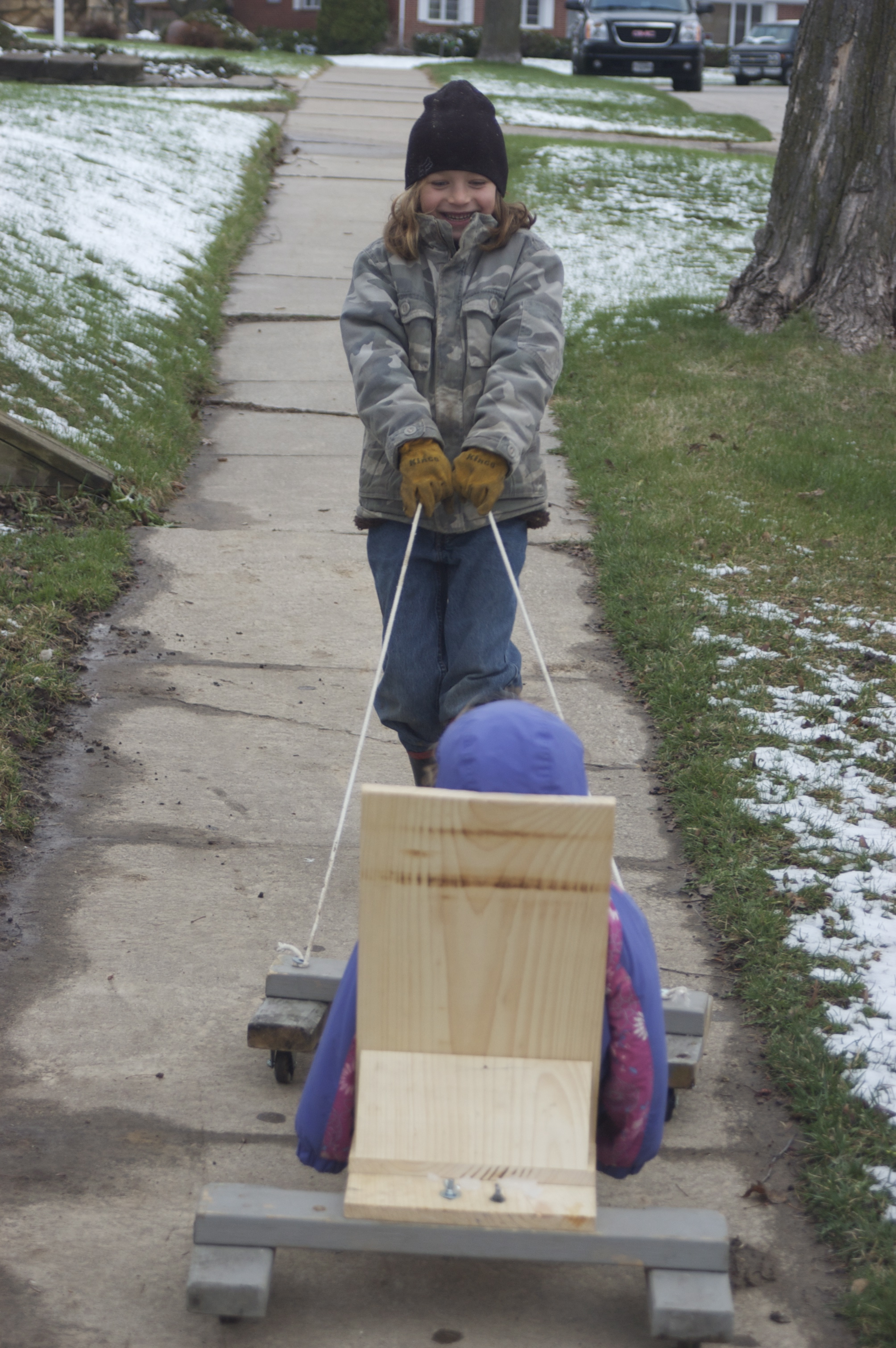
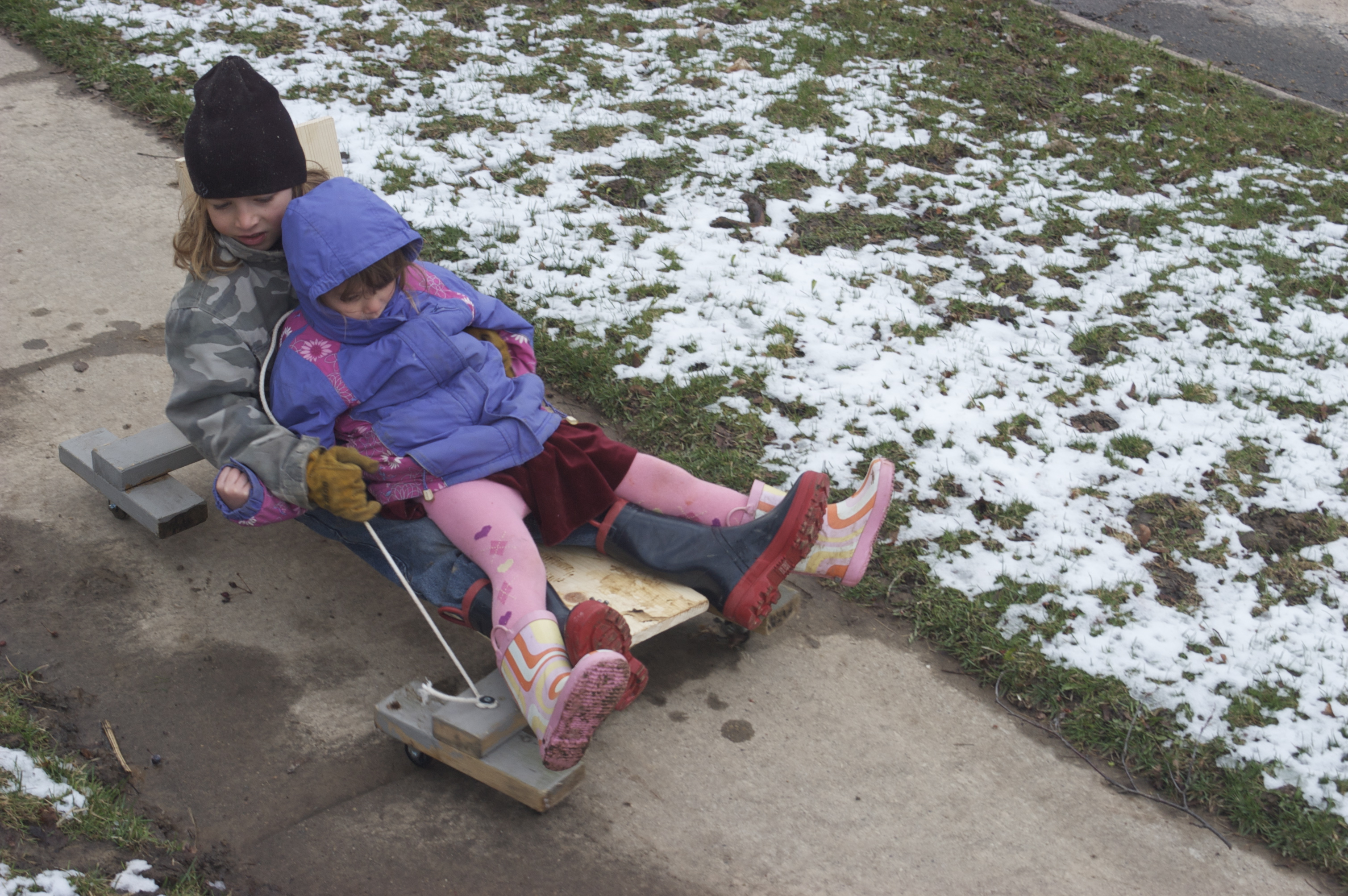
Sage is a child who would likely trade every toy in the house for a stack of lumber. He was in his bliss and set to work immediately. While Pete built my birthday gift Sage worked at his own workbench, transforming the lumber, two old balance beams, some wheels and rope into this:

DSC_2940

DSC_2942

DSC_2933

DSC_2967

DSC_2965

DSC_2970

DSC_2976

DSC_2927

He had some papa help with the angle of the seat (the concept was his own but he needed help with putting that part together). The front wheels pivot and it is steered by the rope. As I watched the kids playing on their new cart I realized: we could have bought him a little ride-on cart. I'm sure there are plenty of ready-made carts and scooters and other toys out there, just waiting to be purchased.

And that, of course, would have entirely missed the point. He didn't get a new cart – he got an amazing experience of building, tweaking, completing, and succeeding. In reality, it isn't about the cart at all.

Unschooling: Learning to Print

DSC_1942

DSC_1952

After Sage taught himself to read he asked me to teach him to print. While he has "know how" for several years, He wants to write stories but tires quickly when printing in his self-taught style. Until now I have never taught him the proper way to print. To encourage his natural learning I allowed him to develop his own way to write, so he often starts and ends at points that are illogical when writing text. (His "S" ends at the top for example).

Now that he has a better grasp on reading and writing, it is time to correct his form. (In a similar fashion he – like most children – often wrote some letters and numbers backwards. This, too, is part of the journey to literacy to I did not often correct but instead allowed it to self-correct naturally, which it did.)

DSC_1944

DSC_1951

We started a homeschooling activity to meet his desire for learning the proper method of printing letters at an easy and playful pace.

I printed out a simple chart showing the proper way to write each letter including arrows (like this one). Each day we choose a new letter and practice writing it in both capital and lowercase on lined paper, using the proper form. (My lined paper is a thrifted ream of vintage kindergarten paper, but you can print out sheets from free downloads too). After 5 or 10 minutes of the letter of the day (which Lupine sometimes joins in on as well) we review the previous letters, write a few words that use letters we have already learned, and then make letter art!

The letter art is based loosely on what I heard teachers do in Waldorf schools, where the focus is one letter at a time and that letter is brought to life through stories and art. We have simplified it a bit, but the letters are very much alive to my children thanks to this activity.

DSC_1926

DSC_1931

The letter art is based on the visual of the larger, stronger capital letter and the smaller, more delicate lowercase. Together the children and I choose an illustration to represent each letter (a capital A-apple tree and lowercase a-apples or a capital B-bear and lowercase b-butterfly for example). Then using our colored pencils we create our picture in the shape of the letters.

It is a wonderful way for the knowledge of the letter to become permanent in the child's mind, and I find the kids both drawing on this activity when working on spelling or sounding out words.

DSC_1964

DSC_1958

We do a letter or two a week and the kids have both enjoyed the process immensely. Sometimes they lay in bed at night trying to decide what tomorrow's letters will become in their art. They are seeing their letter books growing (Lupine and I do her illustrations together), and by the time we are done Sage will have an alphabet book of his own creation as well as a deeper love and knowledge of letters and printing.

The Real Story of Our Chapter a Day.

DSC_1335

DSC_1429

DSC_1430

DSC_1338

Yesterday was like everyday. By mid-afternoon we had eaten lunch and each of us had washed our own dishes and set them to dry. The tea was steeping. And then, like everyday, we headed to the family room for our chapter. Each day that we are at home we follow the same rhythm. Not a schedule mind you, but a tempo for our day. And after lunch and before we head outside we end up here. On the couch.

Sage, Lupine and I snuggle in under the afghan (recently discovered in my hope chest), three mugs of steaming tea on the coffee table. We pick up our chapter book and cozy in.

Yesterday Sage snuggled in extra close with a dreamy look in his eyes and said, "Mama, this is my favorite part of the day." He hugged me. I hugged him back.

It is a simple formula, really. A magical book. A chapter a day in the quiet of the afternoon. The family room couch. A warm blanket. Some tea. Lupine on the right, Sage on the left. Predictable, comfortable, safe. The same rhythm, day after day.

We all thrive on this tempo, knowing exactly what to expect and when. I love how it centers and connects the three of us. We join in the story as it unfolds, spun in the mystery and magic of the tale. We don't watch television or movies, so I suppose this is our answer to that story-spinning and relaxation that many find before the screen. The difference, though, is that our minds create the magic – the pictures, the tone of each voice, the scene – and we connect so deeply with each other during the telling. We live in the story day after wonderful day.

Yes, Sage. It is my favorite part of the day, too.

P.S. Our current book is the Wind Boy by Ethel Cook Eliot. I can not recommend it highly enough. Sweet, convincing magic with just enough plot for a four-year-old, an eight-year-old, and a thirty-seven-year-old.

Democracy Lessons.

  DSC_1211

DSC_1214

DSC_1201

I did mention that I'm from Wisconsin, didn't I?

Wisconsin made a bit of news this week, in case you hadn't noticed. Our new Governor has introduced a budget repair bill that is being met with enthusiasm, though not the kind he was planning on. The democratic senators have left the state to prevent a vote on the bill until more discussion can happen, and schools closed throughout the state as teachers called in sick and traveled to Madison to protest. (We even have our own Wikipedia page if you are interested.) Regardless of your politics it makes for a good story at the very least. Democracy!

On Saturday I loaded my kids into the car and headed to Madison. I wanted to see this historic Wisconsin moment first hand and share it with my kids – Sage in particular. I wanted to give them a first hand experience with democracy in action. As homeschoolers this was an amazing opportunity to learn about our government.

DSC_1249

DSC_1266

DSC_1245

What we saw in Madison was nothing short of amazing. Thousands of people, standing together and particiapting in the story of Wisconsin and the workings of our government. I didn't see any apathy here. When the crowd in the capital started chanting "This is what democracy looks like!" I got goosebumps. Regardless of your politics, this is what democracy looks like. We were safe to stand up to our government, to chant and shout and drum and yell. We were safe. Because as poorly as I believe our democracy functions, it is still a democracy.

Sage and Lupine were transfixed by the crowds, the signs, the songs, the chanting, the passion. They had never seen anything like it.

DSC_1307

DSC_1305

DSC_1293

Finally we left the capital building and watched the march of thousands that encircled the capital square. Sage had a lot of questions about the government, the budget bill, and democracy. With his new reading skills he also had a lot of questions and commentary about the signs. It was his first real introduction to the workings of our government, to politics, to democracy.

The protest was peaceful, passionate, and even – at times – humorous (see below). We left for home feeling our freedom in a different way than we had before. Because whether that voice will be heard or not, we were able to raise it. Becasue this is, after all, a democracy. And hooray for that.

DSC_1283

DSC_1204

DSC_1298 


Unschooling: Learning to Read.

"About reading, children learn something much more difficult than reading without instruction – namely, to speak and understand their native language. I do not think they would or could learn it if they were instructed. I think reading instruction is the enemy of reading. " ~ John Holt

The only ultimatum I ever remember issuing to my mom was about homeschooling.

It was last year. She was concerned that Sage, then 7 1/2, could not yet read. Yes, he could read a little but he couldn't read like kids learn to do so young in public school, her baseline for when certain things should happen developmentally.

This worry had been coming up again and again for her since Sage reached "school age". She feared that if he did not learn to read – and soon – that the door would close on him ever becoming a passionate reader. She felt that at 7 1/2 he was late.

DSC_1008

I did not share her concerns.

Because I – like most unschoolers – believe that given a nurturing environment, all children will learn to read at their own pace. In their own time. I also believe that the optimum time to learn to read is much, much later than the public school system would have you believe. And at 7 1/2 Sage has just entered the realm of reading.

If we are there for them to read to them and provide inspiration and guidance (and we shake off our worry and trust their journey) they will learn. We didn't teach our children to walk. We didn't teach our children to talk. We simply stood by them and watched in amazement as they learned on their own, when they were ready.

I handed my mom a couple of John Holt books and urged her to pick up a copy of Better Late Than Early. I urged her to do some reading herself so that we were at least speaking the same language and then we could have a meaningful conversation about her concerns – if any remained. I told her she didn't have to agree with me, but we had to at least be on the same page of understanding.

The ultimatum was this: Educate yourself or never bring this up again. We are not operating from a place of mutual understanding because we are believing in completely different realities. I perceived a door as just opening that she believed had already begun to close.

DSC_1011

She took the books and we changed the subject. It never came up again.

Fast forward one year. Sage taught himself to read. At 8 1/2 years old he started reading with passion and gusto and (gasp!) no lessons, curriculum, or interference by me. He has friends who are 10 and not truly reading yet and others who at 6 were reading and writing passionately (self-learned). Yes, we can teach them to read before they are ready but that defies logical and good common sense. It defies the entire point of education.

DSC_9271

Pete and I have caused a stir by breaking the mold of our western culture with many decisions in the past decade or so. We're making up our own story and in many ways it doesn't at all resemble the experiences that we grew up with (some parts do, as my mom broke the mold herself in the 1970's by breastfeeding, cloth diapering, and her passion for natural, unprocessed foods).

My mother and I have a truly wonderful relationship. I consider her a friend and she has acknowledged that I come up with a lot of "hair-brained ideas" that turn out to be healthy/safe/or otherwise wonderful upon further research. The list of "Rachel's-seemingly-crazy-but-actually-wonderful ideas" includes homebirth, elimination-communication, extended breastfeeding, cosleeping, intact boys (non-circumcision), delaying solid foods, natural immunity (non-vaccination), naturopathic medicine, homeopathy, and unschooling. I'm sure there will be plenty more to add to our list soon, but that's about how far we've come thus far. Child-lead reading is being added to her list at this moment.

And as I look over this list they really all come down to the same thing: trust in a simple and natural way of doing things, and freedom from fear. I believe in my body, my kids, the nourishment or real food. I am not afraid of things going terribly awry if I don't get in the way of it somehow. I know that it is all unfolding perfectly.

I trusted Sage to make this leap when he was ready. And he did. I'm grateful every day that I didn't get in the way of this beautiful, gentle, natural journey. And now – quite literally – a new chapter begins. Because he was ready.

Unschooling: Our Daily Rhythm

DSC_0683

After I shared our Family Planner with you I got quite a few emails looking for more information. How do we organize our day? Where does "schooling" fall into our schedule? When do I have time for play?

I thought I would share our daily rhythm with you to give you a feel for how we organize our weeks for the most relaxed, joyful, natural learning experience we can. For me removing distractions (telephone and computer specifically) is critical for me to be present and available and in the flow of our rhythm.

Developing a family rhythm is not just for homeschoolers. A rhythm is helpful for transitioning your children in and out of their school day as well as for parents home with babies and toddlers. We all thrive when we have a predictable, comfortable rhythm.

There are of course many exceptions every week. Field trips, appointments, errands, play dates, and gatherings all pull us joyfully from our routine, but it is the springboard for our days. Here is how we roll (most days anyway).

DSC_8988

7:30 – 9:00 Early Block

First thing in the morning we get ready for our day. Each child has their own checklist that contains tasks like "hang up your jammies, make your bed, and put away laundry". (Little ones like Lupine initially require hands-on assistance and a picture checklist, while Sage can go it alone with a written checklist.)

We wash a load of laundry, cook, eat, and clean up from breakfast, and begin our day together. I check email and do a little computer/LuSa work during this early slot.


9:00 – 11:30 Morning Block

This is our inside learning time. As unschoolers I believe it is more important to simply be available to my kids rather than schedule specific lessons, but this is the time so much of the learning happens here. While we don't follow a curriculum there is learning happening at a startling rate – much of it before lunch time. We read books, play games, work in the kitchen, do projects and experiments together. We play with numbers, blocks, the microscope, puppets, art supplies. It is our "school" time.

DSC_0324

11:30 – 2:00 Mid-Day Rest

After our morning block we prepare, eat, and clean up from lunch. We take some time as a family to tidy up from our morning and also all do our housekeeping chores during this time. (I clean a different room each day (in a perfect world anyway), so this happens during this slot. The kids also take a bit of quiet time to be alone, playing quietly for Lupine and reading or drawing for Sage. During quite time I can tend to some LuSa business and check emails.

DSC_8778

2:00 – 4:30 Afternoon Block

This is our ideal time to get outside and play. In the summer we hike and forage, bike and swim; in the winter we walk the dog, sled, or ski. In the winter I need this block scheduled because (like Lupine) I could easily stay in all winter. Sometimes the outside time is just a few moments, sometimes most of the day. There is flexibility and flow in our rhythm.

4:30 – 6:30 Dinner Time

We fold and put away laundry, cook and eat dinner, and tidy up from our day. The kids often play alone while I cook or stand beside me and help.

7:00 – 8:00 Bedtime

Our kids have a fairly early bedtime. It works so well in our world, as regardless of what time they go to sleep both will rise with the sun. Lupine is lights-out by 7:00 or 7:30 at the latest, Sage an hour later. We read lots of books to unwind for the hour before lights-out, then the day is closed for our kids.